
Within 6,000 km² (2,317 square miles) the Russians Could Win the War
With the complete conquest of Donetsk Oblast, the war could come to an end.

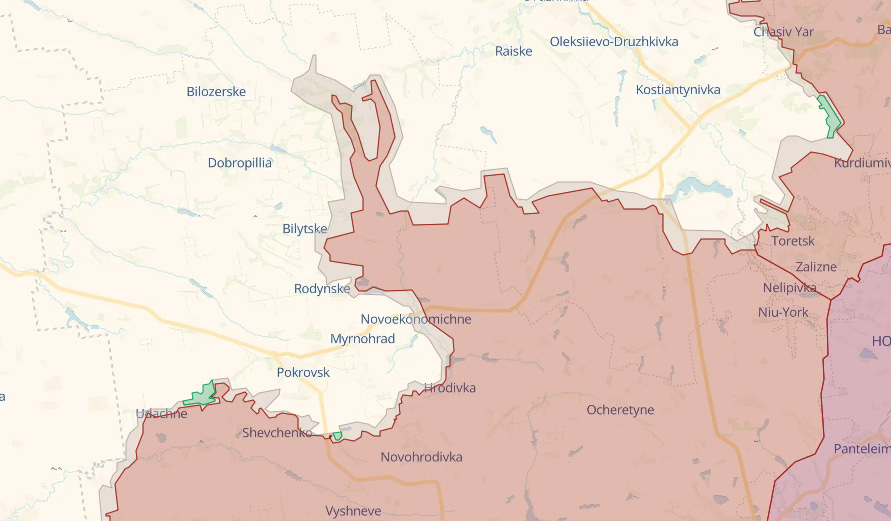
In recent days, between Pokrovsk and Kostyantynivka, the Ukrainian front has been breached.
This is a relatively limited area which, for now, does not hold decisive strategic value. Yet its importance cannot be measured solely in kilometers.
Indeed, if Russian forces were to consolidate these positions, raise their flags, and launch drones from there, the conflict could enter a new phase. In fact, the final phase.
Since the beginning of the invasion, Moscow has pursued four objectives: two central and two complementary. One of these concerns the complete control of the Donbas, made up of the regions of Luhansk and Donetsk.
As of today, roughly 6,000 square kilometers of this territory remain outside Russian control. A portion which, if captured, would represent the fulfillment of one of the main goals declared under the so-called special military operation.
But here lies the crucial question: once this objective is achieved, will Russia truly stop? Or will the war, instead of ending, become even more ferocious and bloody?
And yes, this is by no means a trivial question. Securing the Donbas — perhaps surprisingly — has never been the true aim of the war. The Donbas is merely one of the four objectives, and even the least important of them.
Will Russia manage to seize these final kilometers? Will it stop afterwards? And above all: what are the other three objectives Moscow is pursuing?
The Current Frontline, the Donbas, and the Last Remaining Free Territories
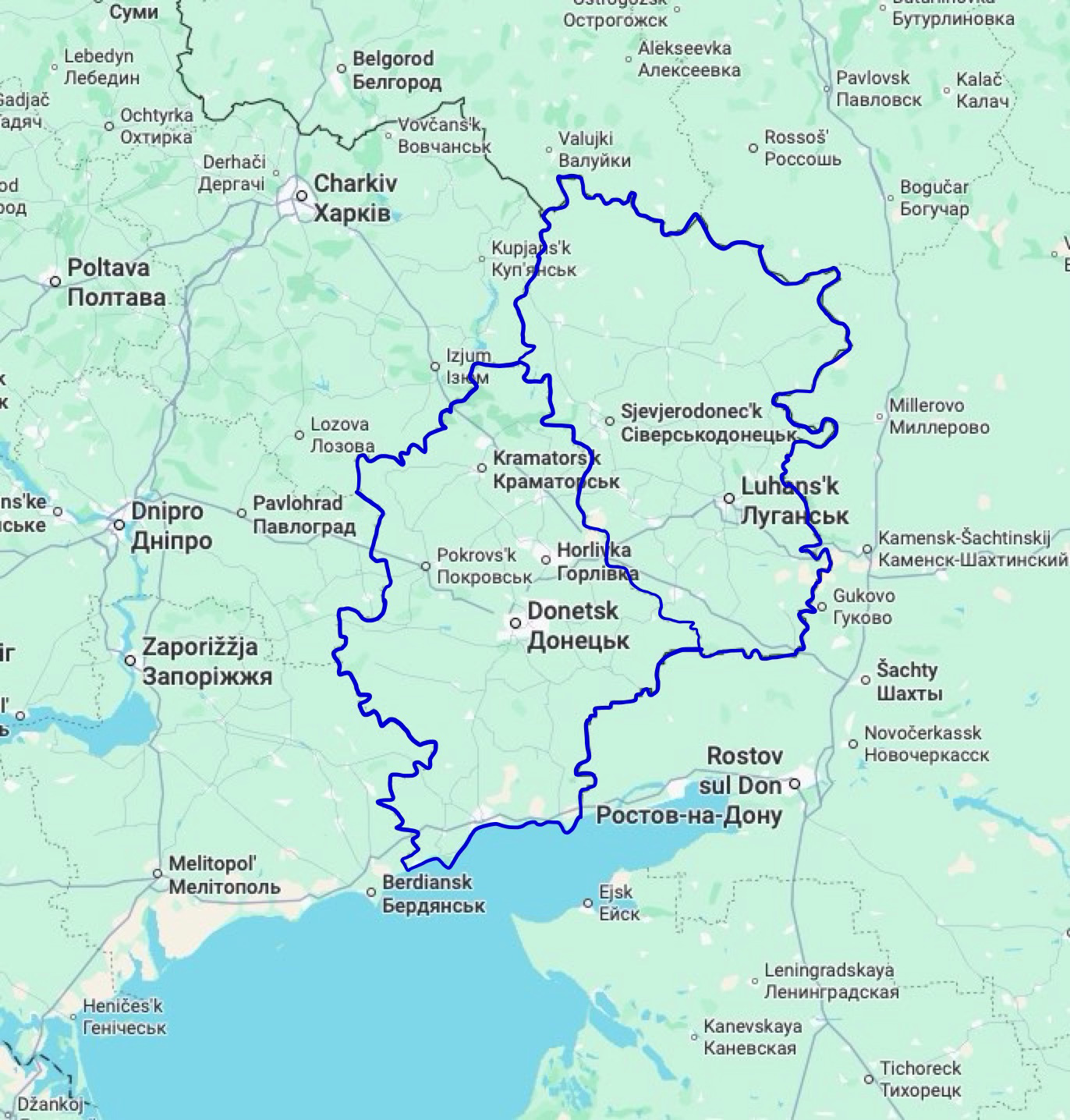
Let’s start with the basics.
What you see on this map is the Donbas, a pair of regions (oblasts) named Donetsk on the left and Luhansk on the right.
This representation does not show the Russian territorial gains made in recent years. Only the regional borders are visible on the western side, and the national borders between Ukraine and Russia on the eastern and northern sides.
As is well known, the war in this part of Ukraine did not begin in 2022, but in 2014. Fighting has been ongoing here for over a decade. As of August 2025, the Russians have captured almost the entire Donbas, with only the last few square kilometers remaining.
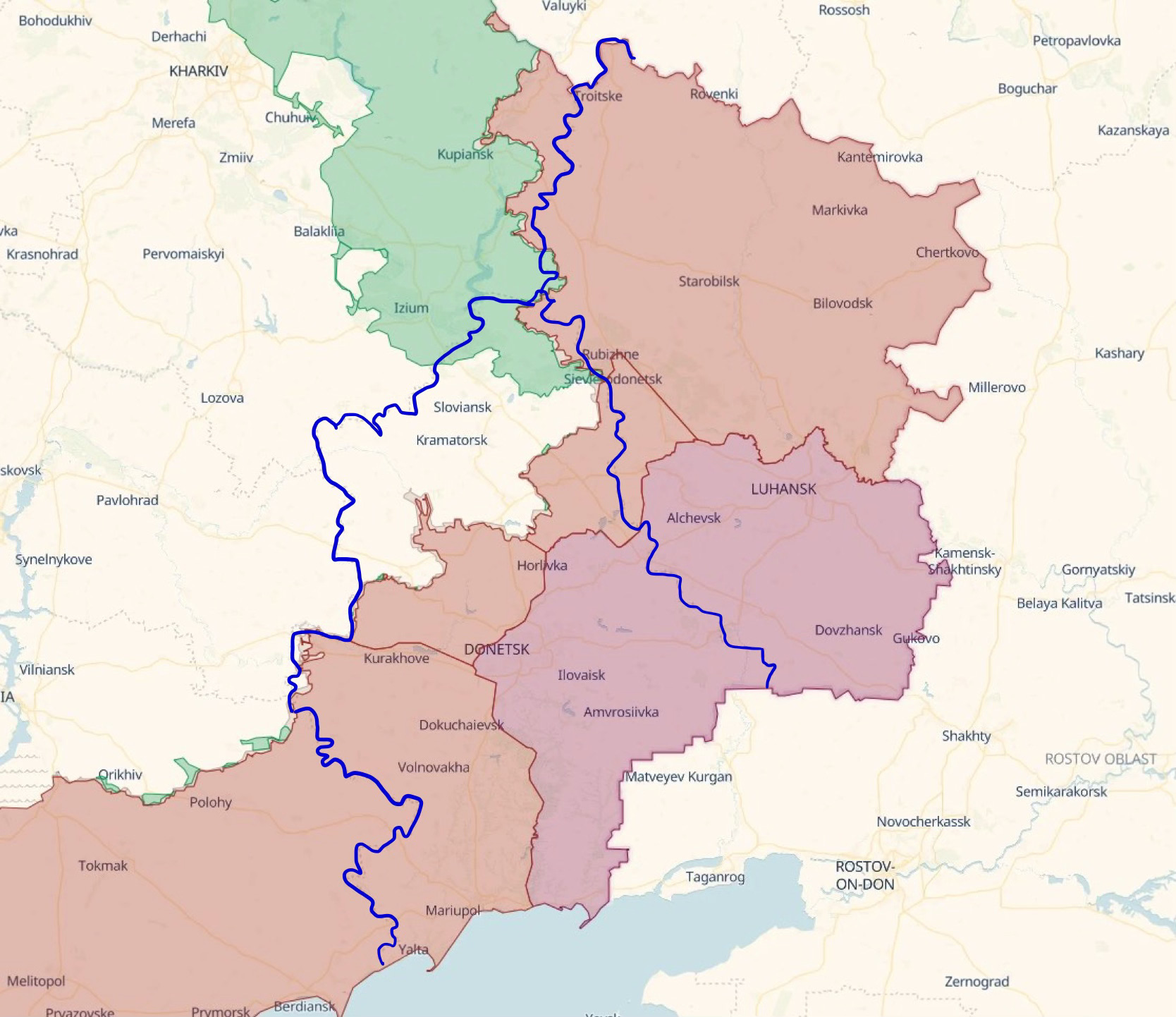
This is the same map as before, depicting the entire Donbas. This time, however, areas currently controlled by Russia are marked in red and purple, updated as of 15 August 2025.
The eastern region, Luhansk, has now been almost entirely conquered. Only about 1% of the territory remains outside Russian control—a portion so small it can be considered negligible.
What deserves our attention, however, is the northern part of the Donetsk region, highlighted in yellow and green.
This is where we need to focus our gaze. Let’s zoom in and take a closer look at this crucial area.
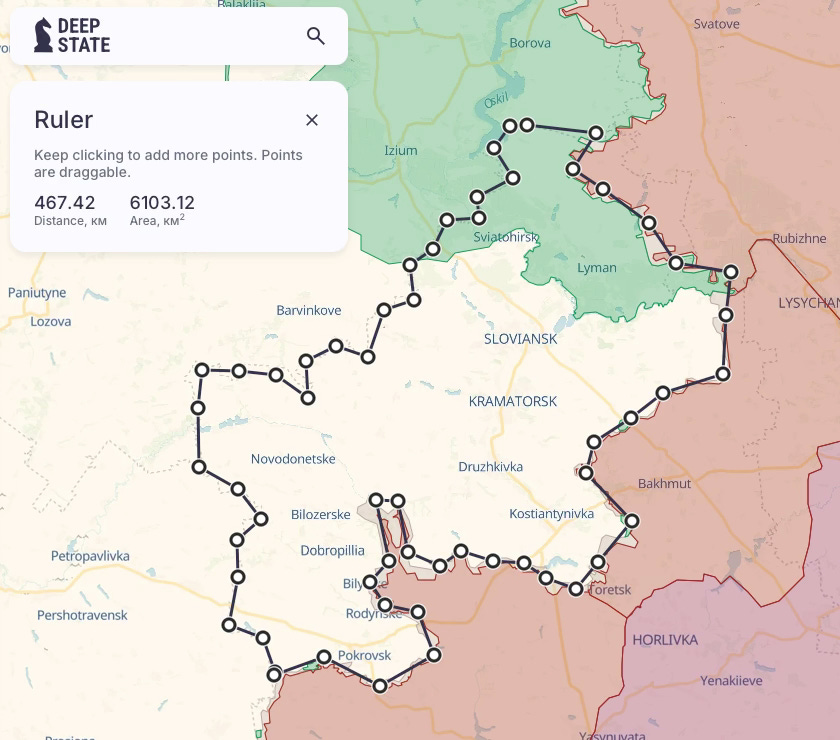
What you see outlined is what remains for the Russians to conquer in the Donbas: an area of approximately 6,100 km², representing 20–25% of the Donetsk region.
As of today, the Ukrainians maintain control of this territory and have been fiercely defending it for over three years. During this time, many territories have been lost—too many territories.
Considerations on Russian Difficulties
These are particularly challenging territories, for both Ukrainians and Russians. Fighting has been ongoing here for more than a decade, and over this period, the Ukrainians have built a dense network of fortifications that has made the war painful and extremely costly for Moscow.
If, after more than three years of large-scale invasion, we are still discussing the Donbas, it is precisely because Kyiv has had ample time to fortify these positions, turning them into a formidable obstacle.
The Russians have not encountered such difficulties elsewhere. In the early months of the war, they rapidly captured vast areas of the Zaporizhzhia and Kherson oblasts—territories that had never experienced combat before 2022 and therefore lacked structured defenses.
Even in the Kharkiv area—which was later recaptured by the Ukrainians—Moscow’s initial advance was surprisingly smooth.
The Breach Opened by the Russians
As mentioned at the beginning of this article, the Russians managed to break through at a critical point, opening a breach clearly visible on the previous map. This is not a simple advance: this maneuver has split some of the best Ukrainian fortifications in the area in two.
If Moscow manages to consolidate this gap, it could bypass the strongest defenses, outflanking them from the rear. In doing so, it would have the opportunity to advance with relative ease, much like what happened a few years ago in Kherson Oblast.
It is no coincidence that the Ukrainian army has mobilized one of its elite units to try to contain this wound. Kyiv is well aware that it cannot afford this knife planted in the soft belly of the contact line.
The Last Territories of Donetsk
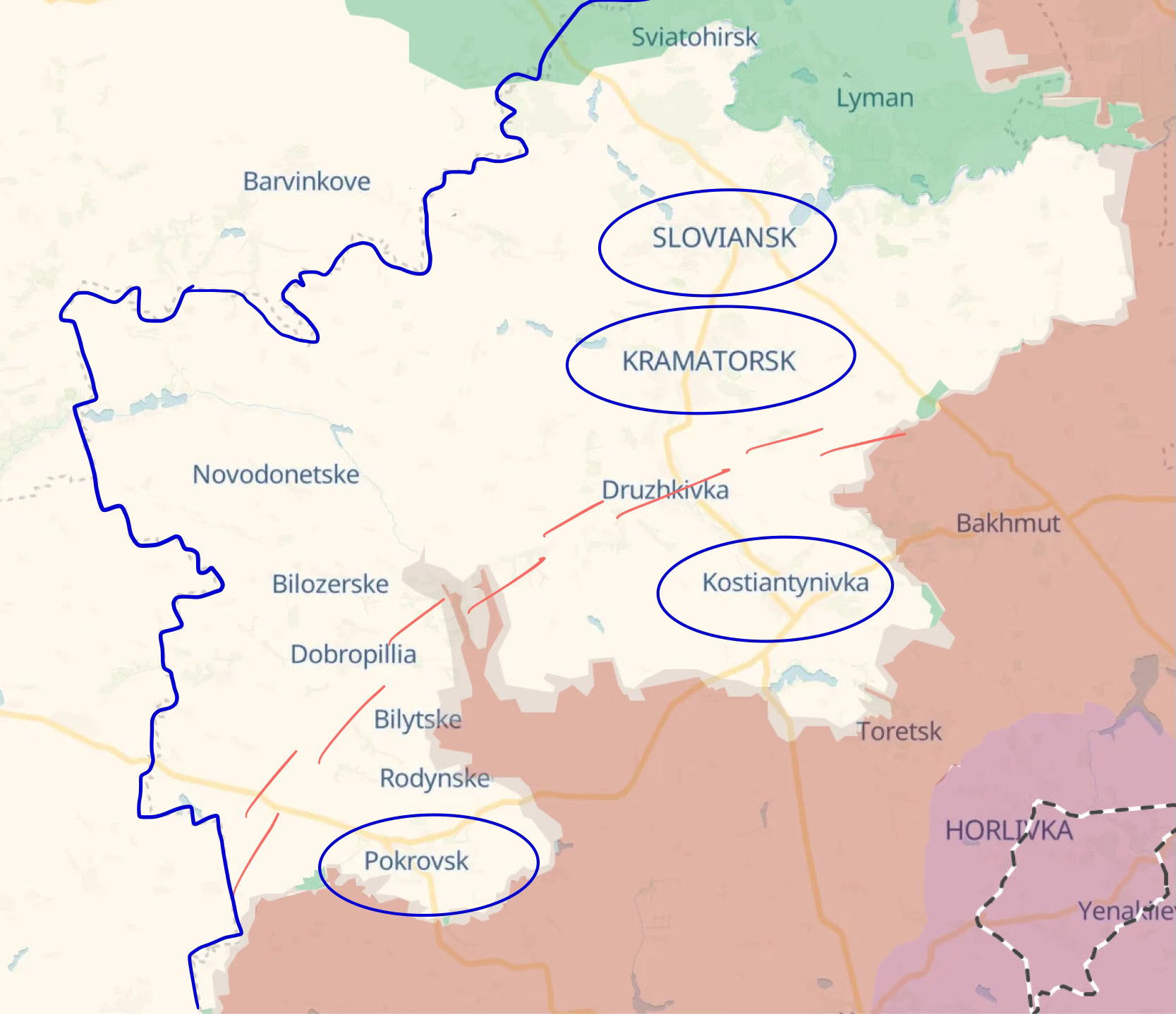
If in the coming weeks the Russians were indeed able to bypass the strongest fortifications, the first plausible objective would be to encircle the Ukrainian forces still present in the cities of Pokrovsk and Kostyantynivka. Subsequently, with the path cleared, they could advance toward larger and strategically vital centers such as Kramatorsk and Sloviansk, the last major urban hubs in the Donetsk region still under Ukrainian control.
A Bittersweet Victory for Russia and Putin
Perhaps we are truly close to the end. Perhaps we are entering the final phase of this war: the stage in which Russia, despite enormous difficulties, gradually manages to conquer the entire Donbas.
But what will happen afterward? Will Moscow really stop once this objective is achieved? Or will the fall of the Donbas only mark the beginning of a new escalation?
It is important to remember: this is only one of the four objectives pursued by Russia. Putin has justified the invasion to his domestic audience as a necessary act to “liberate” the Russian-speaking population of the Donbas. A narrative useful for internal purposes, but one that conceals the reality: the underlying causes of the conflict lie elsewhere, and the Kremlin continues to pursue them even today.
The crucial point is this: will the Russian government be satisfied with a Pyrrhic victory, limited to the Donbas, or will it attempt to push further, aiming for far more ambitious objectives?
In the past, I have already mentioned the hypothesis of a possible Russian plan targeting Odesa, a city that would grant Moscow full control over the Black Sea.
Yet declared objectives and actual successes do not always align. The Kremlin could choose to stop here, in order not to further strain the domestic economy, public opinion, and—above all—human lives.
It Is Not in the West’s Interest for the War to End
I will conclude this article with one final reflection.
Day by day, it becomes increasingly clear that Ukraine has been used by the West as a battering ram: a tool to strike Russia, force it to expend men, resources, and money, isolate it from the European context, and economically weaken it through sanctions.
For this reason, if the war were to end today, Kyiv would not regain its territories. Rather, it would be the West that loses the opportunity to wear Moscow down completely.
The Ukrainians thus find themselves fighting a war that, on the surface, appears to have the objective of a simple territorial conquest. In reality, they have unwillingly become the armed wing of the United States and EU, engaged in a struggle that extends far beyond the borders of the Donbas.
In this scenario—marked by the breach in Ukrainian fortifications and the last 20% of the Donbas still to be conquered—it becomes crucial to ensure that Kyiv holds out as long as possible.
For us Europeans and Americans, it is in our interest that the war continues: that the battering ram keeps pushing and that the sanctions do their work.
Why?
Because if we allowed the Russians to complete the conquest of the Donbas, Moscow could declare victory and halt operations. At that point, the offensive initiative would fall back on the Ukrainians, and attacking—as is well known—costs far more than defending, both in terms of human lives and resources.
For this reason, now more than ever, we must make every single Russian advance extremely costly, every meter gained across those 6,000 km² still free. Only in this way will the Kremlin be forced to continue expending men and resources, hoping to present its domestic audience with a victory to showcase.
And even if we do not know whether Putin will choose to stop once this objective is achieved, one certainty remains: it is worth defending Kramatorsk and Sloviansk to the last breath.
If Moscow were to conquer the entire Donbas, it would have achieved only two of the four objectives of this war. The other two—the most important—would remain unfinished.
If you want to know what they are, I discuss them in depth in this other article.
Thank you for reading. I look forward to your comments and leave all my references here.
Per aspera ad astra.