
With the (Almost) Over War: Israel Comes Out Diminished. Iran and the US, the Real Winners.
Iran’s Nuclear Program? Wounded, Yes — But Still Alive.

Let’s pause for a moment.
We could spend hours applauding ourselves, patting each other on the back. We could praise the surgical precision with which the United States struck Iran’s three nuclear facilities. We could even count — one by one — the scientists taken out by Israeli intelligence. And maybe raise a glass in satisfaction.
But there’s an uncomfortable truth no one seems brave enough to say out loud: Iran’s nuclear program hasn’t been destroyed. Not even interrupted. It’s still there — slowed down, perhaps, but very much alive.
Sure, we can celebrate the Israeli pilots, who intercepted dozens of missiles. We can marvel at the air superiority displayed over Tehran’s skies. But does any of that truly matter if the heart of the issue is still beating?
Where’s the proof that the nuclear facilities have been rendered harmless?
Who can confidently say that the atomic program has been crushed — or even permanently halted?
The truth is bitter: this is not a victory.
Not for Israel, which struck, yes — but didn’t solve anything.
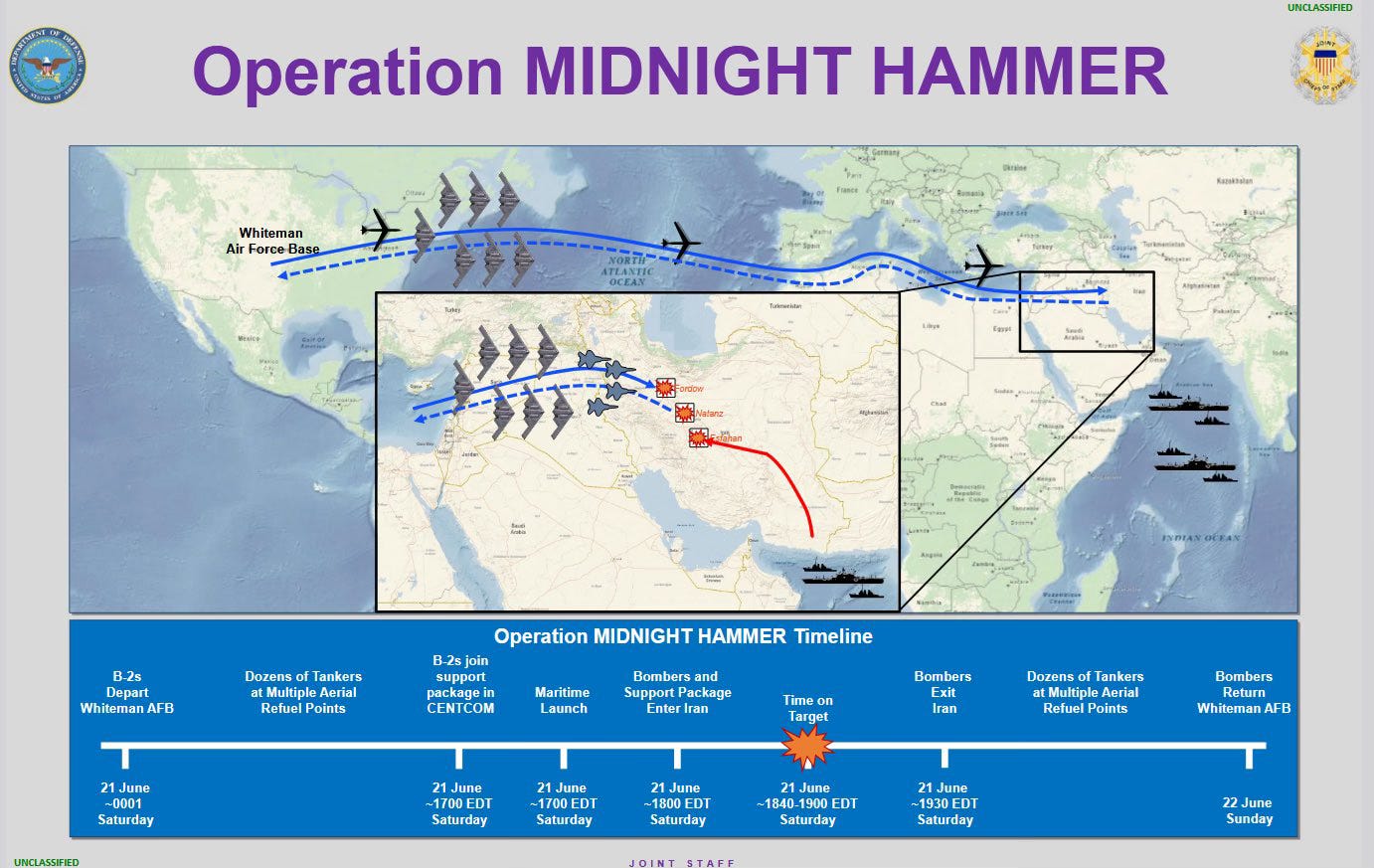
Partially for the United States, which flexed its muscles — 14 bombs, 30 Tomahawks, dramatic B-2 Spirit raids — yet failed to seal the coffin on Iran’s bomb-making capabilities.
And certainly not for the so-called “free world,” which likes to believe it “sent a message,” while the umbilical cord connecting Iran, Russia, China, and their regional proxies remains firmly in place — though perhaps not for long.
The result?
The instability in the Middle East endures.
Western media keeps spinning tales, and Donald Trump calls it a “tremendous victory”...
The West settles for symbolism: the six bomb entry holes at Fordow, while Iranians quietly pick up the pieces and push on, heads down.
I’m an optimist — but not a fool.
I can’t stand propaganda or half-truths.
Our democratic culture is built on freedom of speech, on transparent information — not on triumphalist headlines meant to numb our doubts.
Celebrating an operation that, so far, has yielded only uncertain results is dangerous. It blinds us. It makes us feel powerful when, in truth, we’re not as strong as we think.
That’s what blogs like mine are for: to scratch beneath the surface and take a harder look at what’s really happening — even when the news isn’t pleasant.
If you believe in that mission, subscribe for free. Thank you.
Trump Pleased the Israelis — and Saved the Iranians.
It’s now clear that Donald Trump was far from enthusiastic about Israel’s direct attack on Iran. Tel Aviv’s decision to launch large-scale military operations targeting strategic sites within Iranian territory was, in all likelihood, neither coordinated with nor approved by Washington. In fact, during the early days of the conflict, Trump appeared visibly irritated and tense — a clear sign that Israel’s maneuver was seen more as a unilateral action than a move agreed upon by allies.
Israel, for its part, made a risky but calculated gamble: act first, force Washington’s hand, and place the U.S. in an extremely delicate geopolitical bind.
Washington suddenly found itself with two problematic options on the table:
On one hand, choosing not to intervene alongside Israel would have meant admitting that Washington had lost effective control over its most unpredictable ally. A dangerous signal — one that would suggest to the world that America is in decline, no longer capable of steering the strategic choices of its partners, even in one of the most sensitive theaters of global geopolitics.
On the other hand, deciding to intervene militarily against Iran would have carried the very real risk of dragging the United States into yet another regional war — long, costly, and with no guarantee of strategic success. Such a scenario stands in stark contrast to the foreign policy trajectory Washington has pursued in recent years: gradually disengaging from the Middle East to refocus attention and resources on containing China’s rise in the Indo-Pacific.
The choice Trump made — to wait, let Israel make the first move, and only intervene later by striking three strategic nuclear facilities — was as pragmatic as it was sophisticated. It allowed the United States to:
Demonstrate military strength through the deployment of B-2 Spirits and Tomahawk missiles, without getting entangled in a drawn-out conflict;
Satisfy Israeli expectations, showing support without fully yielding to Tel Aviv’s agenda;
Send a clear message to Tehran: America can strike hard, but it can also choose restraint;
And finally, reassert itself as a reliable mediator by imposing a ceasefire that avoided the worst, and — paradoxically — ended up benefiting Iran as well.
Iran Was Bombed — and Paradoxically, Saved — by the U.S.
One of the most overlooked yet fascinating aspects of this crisis is Iran’s position.
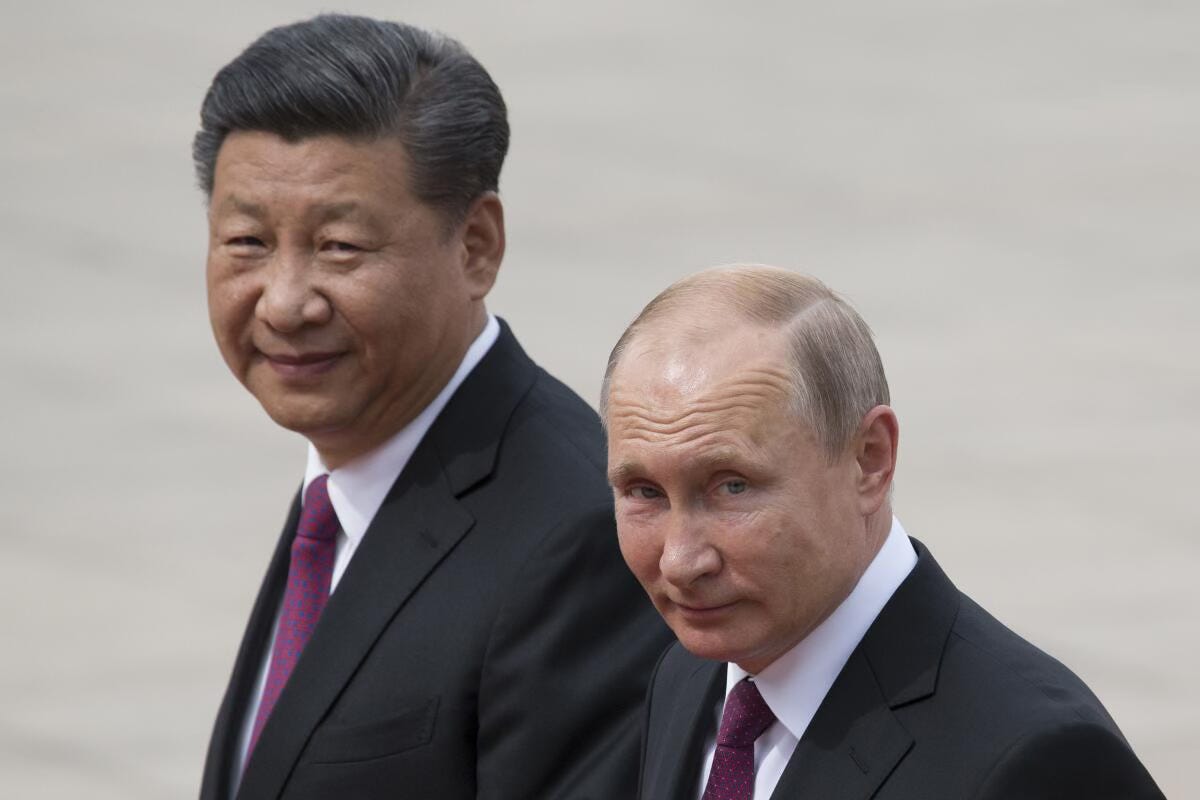
In this phase, Tehran appeared more isolated than ever, despite its alleged strategic alignment with Moscow and Beijing.
In reality, neither Russia nor China took any concrete action.
Moscow, deeply bogged down in Ukraine and unwilling to stretch its military resources even thinner, had no interest in opening a new front — one that would only increase international pressure on the Kremlin.
Beijing, for its part, did everything possible to prevent the militarization of the Strait of Hormuz, given that 40% of its energy imports pass through that critical waterway. Any escalation would have jeopardized oil supplies and threatened the entire foundation of China’s low-cost, energy-dependent economic model.
This indifference from Russia and China made one thing painfully clear: the CRINK alliance is purely instrumental. Neither Moscow nor Beijing has a genuine interest in defending Iran — only in using it when convenient. The moment the risk of being dragged in grew, both quietly stepped back.
And that’s where the U.S. move gains even deeper meaning.
The ceasefire imposed by Trump — though it came after a devastating strike on nuclear infrastructure and following Iran’s retaliatory attack on a U.S. base in Qatar — offered Tehran an “honorable” exit route, allowing it to:
avoid an all-out war with Israel;
preserve parts of its nuclear program (the full extent of the damage remains unknown due to the underground nature of many facilities);
and most importantly, reconsider its diplomatic options in a world where its so-called “historic allies” failed to show up when it mattered.
The Nuclear Program Has Been Slowed — Not Defeated. Time Is on Tehran’s Side.
As of today, there’s no conclusive evidence that the joint Israel–U.S. strike has wiped out Iran’s ability to continue its nuclear program.
The targeted facilities — including Fordow, the most well-known and heavily fortified — are underground installations. Assessing the actual extent of the damage will likely remain, at least in part, a mystery forever.
What we do know is that not all installations were hit.
We don’t know whether the enriched uranium was evacuated.
We don’t know if the centrifuges are still operational — and if so, how many, or where they might be.
But we can reasonably assume that, even if slowed down, the program has not been dismantled.
Which means the nuclear bomb hasn’t been stopped — just delayed.
So the question is no longer “Will Iran get the bomb?” but rather: “How soon?”
And it’s precisely within that time window that the real diplomatic battle will unfold.
And if that’s truly the case, then let’s say it plainly: the only clear loser here is Israel.
Tehran has taken a heavy blow, suffered major damage, and perhaps — we don’t know for sure — has entirely lost use of the three targeted facilities.
But none of that prevents it from continuing, albeit more slowly, to pursue its nuclear weapon.
Divide and Conquer: The Endgame Might Not Be to Destroy Iran, But to Isolate It.
Trump, perhaps without even meaning to, followed one of the most ruthless and enduring maxims of the Roman Empire: divide et impera. You don’t need to destroy an enemy if you can isolate it.
You don’t need to annihilate it if you can make it question its allies.
And now, something is starting to crack.
Iran fought alone.
It came under attack and received no help.
It looked to Moscow and Beijing — and found only silence, or worse, calculation.
Russia, bogged down in its war with Ukraine, can’t afford to open another front or burn what little diplomatic capital it has left. Iran is only useful to the Kremlin as long as it contributes to the war effort in Ukraine.
Not an inch beyond that.
China, which buys oil, gas, and influence from Tehran, has no interest in destabilizing the Strait of Hormuz, a vital artery through which nearly a third of the world’s oil supply flows. If Iran sparks an international crisis, China pays the price — and Beijing knows that all too well.
So now, Tehran may be starting to ask itself an uncomfortable question:
Have we been used by our allies — and tossed aside when no longer convenient?
It’s into this strategic vacuum that American ambiguity steps in. Yes, the United States struck Iran. But it also negotiated. It displayed strength, and then immediately pushed for a ceasefire.
I didn’t protect Iran — but it did keep it from sharing Gaza’s fate, bombed into oblivion by Israel.
In foreign policy, it often matters less who protects you than who gives you an exit route.
And if the only power offering you room to maneuver is the one you’ve hated most — then perhaps it’s time to reevaluate your friends and foes. Or at least, figure out who — beneath the rhetoric — is quietly giving you a hand.
This isn’t about an alliance — absolutely not.
But it is about something subtler, more dangerous, and more destabilizing:
a drifting Iran, no longer fully tethered to Moscow or Beijing. An Iran that, pushed into solitude, may begin to look around.
An Iran with no alternatives is an unpredictable Iran.
An Iran that realizes it stands alone is an Iran ready to shed its skin.
Not out of affinity — but out of survival.
And so yes, the real American bet may not be the nuclear bomb — which remains a very real threat, just postponed.
The higher-stakes, less visible, but far more radical gamble is the disintegration of the anti-Western axis.
Not through force.
But by laying the cards on the table, and showing Iran just how self-serving and shabby its chosen allies truly are.
If this strategy works, if Iran really starts to loosen its ties with Moscow and Beijing, we could witness an unprecedented geopolitical earthquake.
Power balances in the Caucasus, the Persian Gulf, the Levant, and Central Asia would be rewritten.
Russian influence would be badly wounded.
China’s Belt and Road Initiative, at least its eastern corridor, could be destabilized.
But beware:
This is a high-risk bet. One misstep — and everything collapses.
The powder keg is still smoldering. Don’t be fooled by the ceasefire, which—for now—holds.
The fault lines beneath the surface are shifting.
And no one knows when — or where — the next quake will strike.
Because if this strategy fails, if Iran feels cornered, humiliated, with no way out, it may decide not to wait any longer.
It could go all-in on developing the bomb as quickly as possible, shut itself off from the world, and become a second North Korea.
An isolated, regressive, widely loathed state.
But nuclear — and thus, with its own life insurance policy.
Untouchable.
Now all we can do is wait.
Per aspera ad astra.