
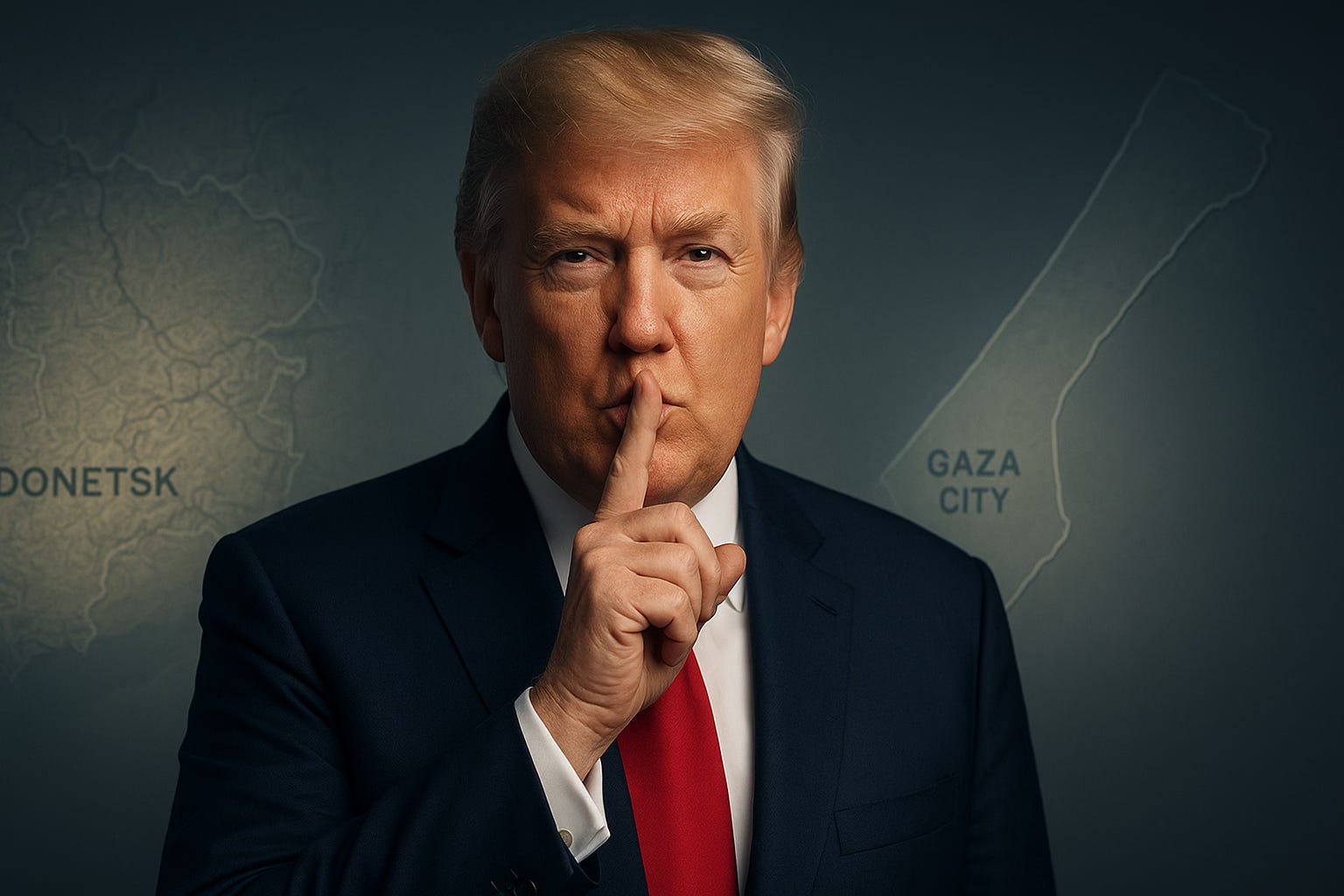
Have we ever stopped to ask ourselves what we’re really watching when we follow the latest headlines from the front every single day? The advances in Kursk, the breakthrough above Pokrovsk, the so-called Ukrainian flamingo, Operation Spiderweb. Headlines designed to grab attention, no doubt. But are we sure they actually help us understand?
Chasing details, year after year, we’ve lost sight of what truly matters: the bigger picture.
Isn’t that the case?
Just go back a few years and it becomes obvious. A few months after the war began, the media obsession was Bakhmut: months and months of debate focused on a pile of rubble that used to be a city. But while we were busy arguing about that, what was really happening behind the scenes?
Don’t we see the danger here? By fixating on marginal events, we risk losing our ability to connect the dots. And without connections, without a comprehensive design, what’s left is not clarity and understanding—but just noise.
And yet, if we listen closely, something significant has already happened: Putin stopped talking about Kyiv almost immediately. Today, it’s only about Donbas.
How many of us noticed that? How many asked why?
Simple questions, maybe even trivial—but fundamental. Because forgetting the big picture means abandoning strategic thinking. It means letting ourselves be dragged along by crumbs of information handed to us, instead of searching for the signal.
So let’s go back to the key question: how do we distinguish signal from noise? Can we really make sense of events without building a framework to interpret them?
Let’s take a concrete example: the summit in Alaska between Trump and Putin.
What was its real purpose?
Was it just a show, or did it serve a precise strategic goal?
Why did the conquest of Kyiv disappear from the Russian narrative, while Donbas remained the core of the discourse?
If we don’t ask these questions, if we don’t learn to zoom out and look at the whole chessboard, we’ll keep chasing headlines without ever understanding the game.
That’s why today we’re taking a hundred steps back. Not to drift away, but to see more clearly. It’s like using Google Maps when planning a trip: at first, you get a general overview, then you zoom in on every single exit. Right now, we’re just following turn-by-turn directions. But after three and a half years of war, we’ve forgotten both where we started and where we’re headed. These turns are now out of context, and we no longer understand their purpose.
Only with a broad vision can we reconnect the dots, read events for what they really are, and build a solid network of understanding—instead of settling for the crumbs scattered across the airwaves and the headlines.
By the end of this article, you’ll be better equipped than ever to interpret information and connect it all together.
U.S. Strategy: Containing China, Expanding the West
In his first eight months at the White House, President Trump tried to play the role of the peacemaker, presenting himself as the man capable of launching a dialogue process between Ukraine and Russia. But was that ever really possible?
Let’s not forget that Donald Trump spent years working in the world of advertising. His flair for drama, his instinct for showmanship, make him a seasoned performer. But international politics is not a stage: in reality, the U.S. acts very differently.
And here’s the point: the United States is an integral part of this conflict—perhaps even more so than the Ukrainians themselves. Washington has financed, and continues to finance, Kyiv, providing economic, political, and military support. Can we seriously believe that the party supplying arms to one side can, at the same time, present itself as the mediator?
So why do they do it? What is the United States’ real interest in Ukraine? Why spend billions to keep it alive and sustain it?
The answer is not to be found in Kyiv, but much farther east. For years—probably since the Obama era, if not earlier—the United States has been preparing for what many analysts now consider inevitable: a major confrontation with China.
The Island Chain: A Maritime Trench
How is Washington preparing for this potential war?
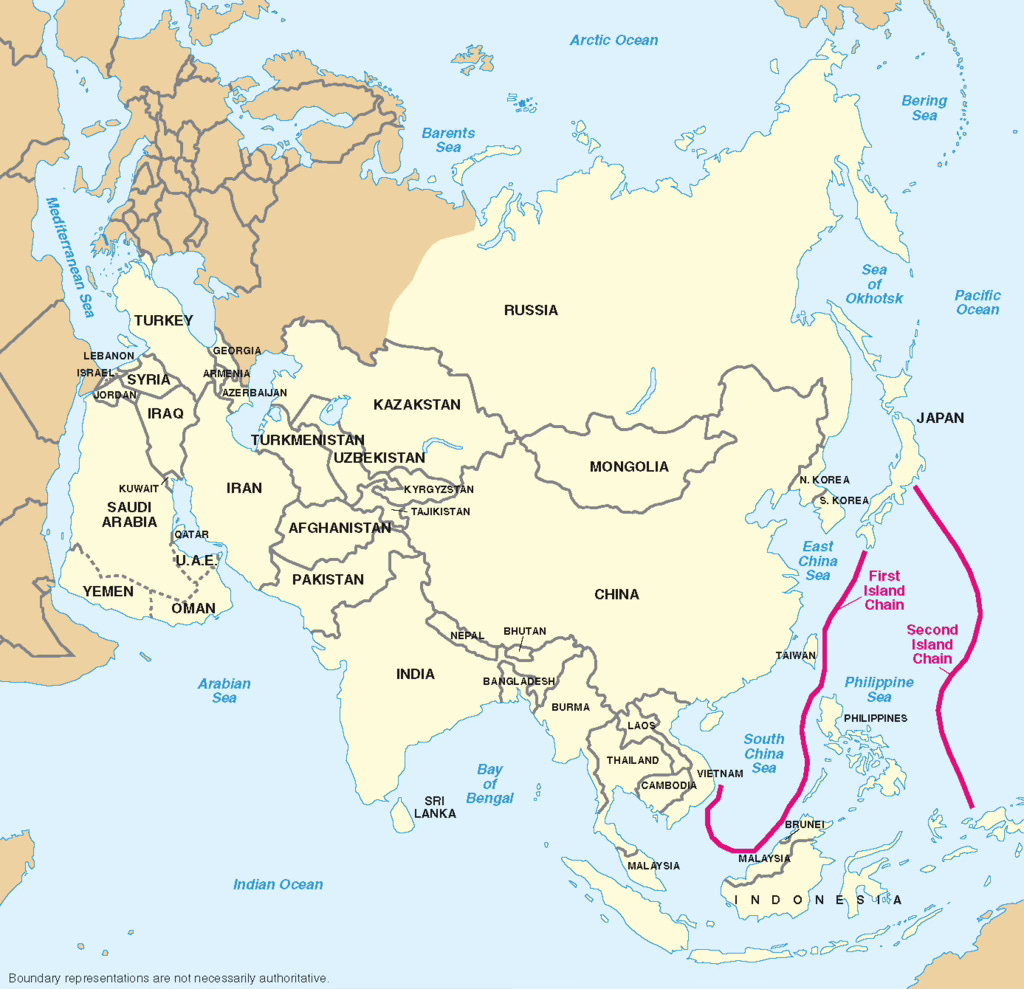
American moves are visible to all—if you know how to read them. A striking example is the maintenance and strengthening of the so-called “island chain” surrounding China, preventing it from freely projecting its military power across the Pacific.
Through a dense network of alliances—with the Philippines, Japan, Taiwan, and many other regional actors—the United States has built a kind of maritime trench. A defensive line composed of archipelagos, military bases, and strategic agreements, designed to physically block China’s naval ambitions.
This is not a new strategy; it has been employed throughout human history. History teaches us that whoever controls the seas controls the world. The Romans, by dominating the Mediterranean, built an empire. Centuries later, the British Empire, master of the oceans, became the undisputed global power.
The Chinese have not forgotten the Opium Wars, British domination, and the humiliation inflicted by foreign powers. These remain open wounds in Beijing’s historical memory.
Controlling the sea is essential.
Today, however, it is the United States that exercises near-total control over the oceans: monitoring straits, controlling chokepoints, and maintaining strategic bases across every corner of the globe.
Isn’t this perhaps the real key to understanding their involvement in Ukraine?
AUKUS
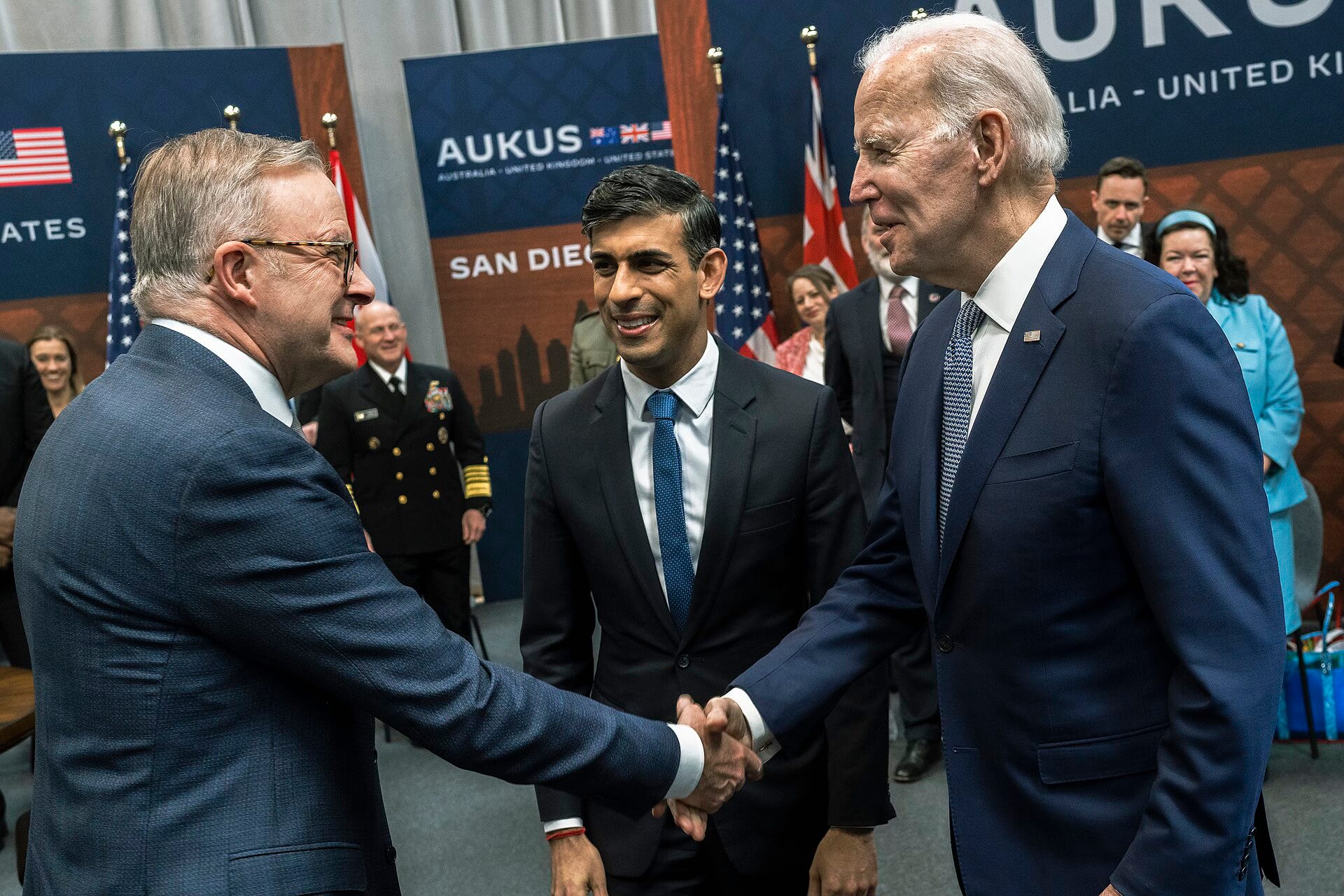
AUKUS—an acronym for Australia, United Kingdom, and United States—is officially presented as a military alliance “aimed at promoting a free, secure, and stable Indo-Pacific.” A polished definition, no doubt.
But is there more? Yes.
If we strip away the niceties, it’s clear that this is an agreement born with a precise objective: to contain China within its own sphere of influence.
Australia, which until a few years ago was not considered a major player on the global military stage, now sits at the heart of the U.S. strategy thanks to AUKUS. Washington provides it with advanced technologies, including nuclear-powered submarines: essential tools for patrolling the vast Indo-Pacific Ocean and limiting the maneuvering capabilities of the Chinese navy.
And that’s not all. Just look at Washington’s moves over the past few years: tariffs imposed on Beijing, bans on exporting sensitive technologies, and a renewed arms race. Isn’t it telling that just two years ago the B-21, the bomber designed to replace the B-2 and specifically intended for high-intensity conflicts, was unveiled?
The United States is preparing, and they’re not even hiding it. In getting ready for a confrontation with China, they are not merely reshaping and reinforcing classic alliances—they are doing so in a more eastern, less European orientation, because the formidable adversary is no longer the Soviet Union, but Communist China.
Strengthening Their Own Alliances and Weakening Others’
If it is true that the United States is preparing for a confrontation with China by reinforcing its own alliances—think of the “island chain” or the AUKUS agreement—it is equally true that they can prepare for this conflict by working in the opposite direction: weakening China’s relationships with its strategic partners.
And this is where things get truly interesting.
Unlike Washington, China does not have a network of historical, deep-rooted, and structured alliances. It cannot boast anything comparable to the long-standing ties linking the United States to the United Kingdom, Canada, Europe, Japan, or South Korea. So, who can Beijing count on?
The answer is simple: on very few, very limited “friends”—or perhaps better described as convenience allies.
In recent years, there has often been talk of a sort of silent, informal, yet recognizable bloc known as CRINK:
China
Russia
Iran
North Korea
These are the only partners China can realistically trust—at least to a certain extent. Three regimes that share with Beijing temporary interests, rivalries with the West, and a common opposition to American hegemony. But can they truly be considered solid allies?
This is why it seems almost inevitable that Washington will do everything it can to undermine this fragile axis. With what tools? All of them: military, economic, diplomatic.
The question we should ask ourselves is:
Is this alliance holding? Are Ukrainian pressures on Russia and Israeli pressures on Iran yielding any results?
Ukraine, Russia, and the Alaska Meeting
If the United States truly wants to contain China, then strengthening its own alliances while simultaneously weakening Beijing’s becomes a strategically desirable objective. It is within this framework, in my view, that we must place the events unfolding in Ukraine—stripped of the camera-friendly show that constitutes noise, not signal.
Since 1945, Washington has never stopped expanding its network of alliances. Every new member, every new accession, is simply another piece in a strategy founded on a clear principle: the more friends you have, the greater your deterrence. Who would dare openly challenge such a vast bloc? Within it, you dominate your allies or vassals and dissuade others from initiating conflict.
In my opinion, this is precisely the logic that, year after year, has driven the European Union—and especially NATO—to expand eastward.
In Europe, the declared objective has always been Moscow. During the Cold War, the USSR was the primary enemy. Today, Russia has become a secondary target: an indirect one. Striking Moscow primarily serves to send a message to Beijing: “You are alone, I am weakening your friends. Don’t make a mistake—it’s not in your interest.”
It is no coincidence that when NATO tried to include countries such as Georgia and Ukraine, Moscow reacted forcefully: invading Georgia in 2008, occupying Crimea in 2014, and launching a large-scale invasion of Ukraine in 2022. The goal was to wrest Ukraine from American influence by changing the regime in Kyiv. When that attempt failed, Russia turned its focus to the war in Donbas.
The likely idea was to start by retaking Kyiv, and then, after terrifying half of Europe with a blitzkrieg, bring the Baltic republics back into its orbit, limiting American influence.
Yet, ironically, Russian attempts to break the American grip on Europe have had the opposite effect: they ended up strengthening it. Today, the United States controls Eastern Europe with an even firmer grip, while Russia is bogged down in a conflict that drains manpower, resources, and international legitimacy.
So, what options remain open to Moscow? In my view, only two:
Capture all of Donbas and declare victory—mutilated, certainly, but still a victory.
Concede something to the Americans in exchange for reduced support to Kyiv, thereby ending the conflict more quickly, claiming victory, and limiting damage.
The problem? Every option appears risky. The Alaska meeting very likely served this purpose as well: to probe the terrain. To understand what the Americans really want in order to relinquish Kyiv and leave the Russians a free hand in Donbas.
But what could the United States demand in return? Money? Territory? Influence in Europe? Too little.
The truth, if you’ve followed the line of reasoning, is that Washington may only want one thing: to force Moscow to abandon Beijing and turn into an American ally.
An ally, yes… but with a gun to its head. An ally who, at the first mistake, would be thrown back into chaos by new border conflicts: perhaps in Finland, Romania, or Poland. Flooded with sanctions and turned into a European North Korea. A place where even electricity is scarce, and in the past people literally starved.
So let us ask: can the Russians really afford such a leap into the void?
My opinion is no—they cannot.
Ukraine and Israel: Different Wars, Same Enemy
Do you know why I’m convinced that this is the correct framework to use for understanding the war in Ukraine and distinguishing signal from noise? Because the U.S. is not only weakening Russia, but also another key Chinese ally: Iran.
The weakening of Russia by Ukrainian forces is not so different from what is happening in the Middle East. The dynamics are similar, almost mirrored: on one side, Iran, China’s ally; on the other, Israel, a strategic partner of the United States, tasked with wearing down Iran’s strength and limiting its influence.
Notice the similarity? In Ukraine as in Gaza—from Avdiivka to Bakhmut, from Khan Yunis to Rafah—what happens on the ground is not just a local war, but part of a broader strategy. Ukraine and Israel, two different actors in different contexts, are pursuing the same goal: to fracture China’s network of friends, weaken Russia and Iran, and thus leave China more isolated.
Atop this large strategic pie sits the cherry: Syria, no longer in the hands of Assad—ally of Iran and Russia—but controlled by a shady figure who nonetheless strikes deals with the U.S. and Saudi Arabia.
And what is the message intended for Xi Jinping? Simple: your allies are fragile, not strong enough, not reliable enough. And if they fall one by one, you remain alone.
Is it really worth risking a global war under these conditions?
Wars, after all, almost always break out because one side believes it is stronger than the other. It worked this way in schoolyard fights, and it works the same way among nations.
So how do you prevent a war? With only two moves: become stronger than the threat… or make the threat weaker.
And that is exactly what the United States is doing: on one hand, forging new alliances like AUKUS and consolidating control over the island chains that block China; on the other hand, through Ukraine and Israel, wearing down Russia and Iran, hollowing out Beijing’s relationships with its most inconvenient partners.
At this point, the picture becomes clear. It’s no longer just about Donbas or Gaza, not even just about Moscow or Tehran. The stakes are much higher: preparing for the true confrontation of the century, the one with China.
And so the final question is inevitable: how many of these “local” wars are we willing to watch without realizing that they are actually part of a global game?
And most importantly: when China realizes it is left alone, will it truly choose to back down… or will that be the moment it decides to risk everything?
Per aspera ad astra.
Thank you for reading. You can find me on these channels. → LINK