
🇺🇦 Ukraine Is Just a Less Awful Russia.
On the protests against corruption and the country’s path toward the European Union.

Western values are a way of life—only afterward do they become state laws:
It’s an uncomfortable truth, I know. But acknowledging a problem is always the first—and unavoidable—step toward solving it. Just like a patient must accept their illness before they can recover, a country must first face its own flaws.
The same goes for Ukraine—and for all those nations, from Turkey to the Balkans, that dream of one day joining the European Union.
European integration is not a symbolic gesture.
It’s a long, complex, often painful journey. A path that demands structural reforms, deep changes, and a radical transformation of institutions.
But let’s be clear: it’s not a punishment.
It’s a process every current EU member state has gone through in one form or another—from Poland to Romania, from Lithuania to Estonia. No exceptions.
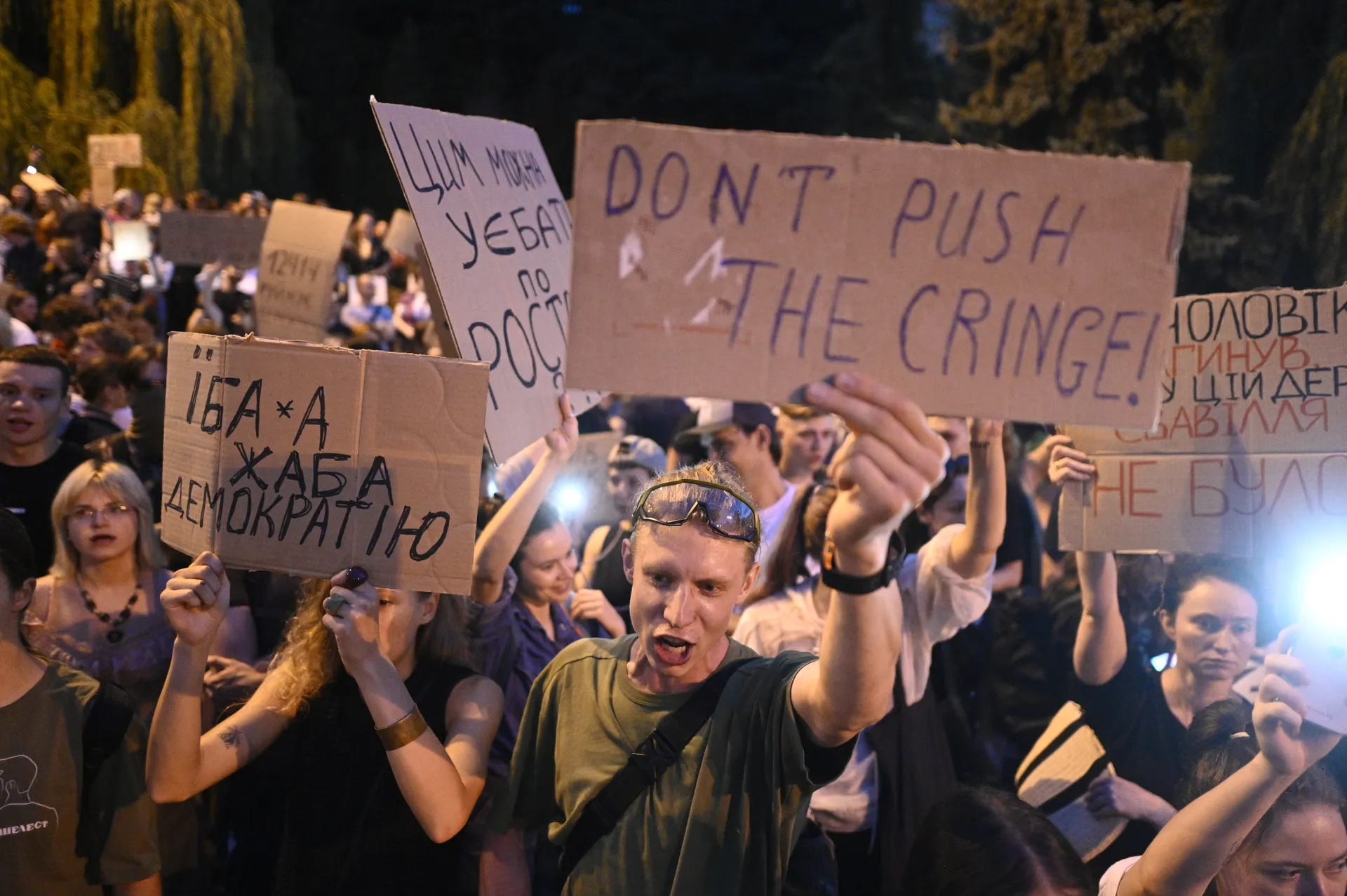
Just a few days ago, hundreds of people took to the streets in Kyiv, protesting against a bill hastily passed by parliament and signed by President Zelenskyy. A bill that undermines the independence of two major anti-corruption bodies.
I won’t go into detail about the events in the square.
Anyone interested can read the Kyiv Independent, an opposition newspaper that's been fiercely critical of the government.
Today, I want to tell you what I think.
I want to talk to you about a country I admire, one I respect for the progress it has made, but which still displays authoritarian tendencies, Soviet reflexes, that make it feel too much like the Russia it’s trying to leave behind.
Yes, Ukraine is a smaller Russia.
But Ukrainians are not “little Russians.” Or at least, not all of them.
A portion of the Ukrainian population holds a European consciousness that is deeper, more mature, and more genuine than what we sometimes see in countries that are already part of the EU.
What happened in recent days is, in fact, entirely normal. It’s part of a wounded nation’s long healing process.
Every path of transformation includes relapses and hesitation.
Mental laziness, moral fatigue, the inertia of old habits... it all weighs heavily.
And yet, it's part of the journey. Because change is hard. Painful, even. It’s hard for us as individuals, and it’s hard for nations—who are, after all, nothing more than the sum of their people.
And yes, change hurts—even when it’s for the better. Perhaps especially when it’s for the better.
The protests that filled the streets of Kyiv reveal a key truth:
Rules are written by people. And people can rewrite them…
But only if they want to.
Real change in Ukraine cannot come from institutions alone. It must begin in people’s minds.
A population that doesn’t know—or doesn’t value—the rule of law, press freedom, open markets, and the fight against corruption, will never rewrite the foundational rules needed to make a Western-style state function.
A people who don’t love freedom will never raise their voices loud enough to force their government to guarantee it.
Not because they’re stupid.
Not because they enjoy being censored.
But because they were never taught to love freedom.
They’ve never been initiated into democracy, the rule of law, or market economics.
That’s why the Russian and Chinese people don’t rise up.
And for now, the same is true of Ukraine.
It’s also the same principle that explains why anyone in the United States can own a gun: in the American mindset, freedom must also be defended by force. In the extreme case of a coup, the people have the right—and the duty—to resist.
Even with gunpowder and buckshot.
Ukraine is a young country, one that has only recently begun to taste freedom and democracy. It’s slowly moving toward Western values, but remains fragile and unfinished.
The catastrophic 1990s—both in Russia and Ukraine—are proof of this: capitalism was introduced overnight to a population that had no concept of private property, had never heard of a stock exchange, and had no idea what shares or investments were.
Even today, many Europeans don’t fully understand these concepts—let alone a Ukrainian Babushka in 1995.
It was a forced transplant. And it created monsters.
The corruption that still plagues Ukraine today is the offspring not only of its Soviet past, where stealing from the state was normalized (and being robbed by the state even more so),
but also of that dark decade in which a handful of oligarchs cannibalized the wealth of an entire nation.
A people who, at the time, had no tools to recognize what was being done to them.
In Ukraine, Corruption Is a Greater Threat Than Russia
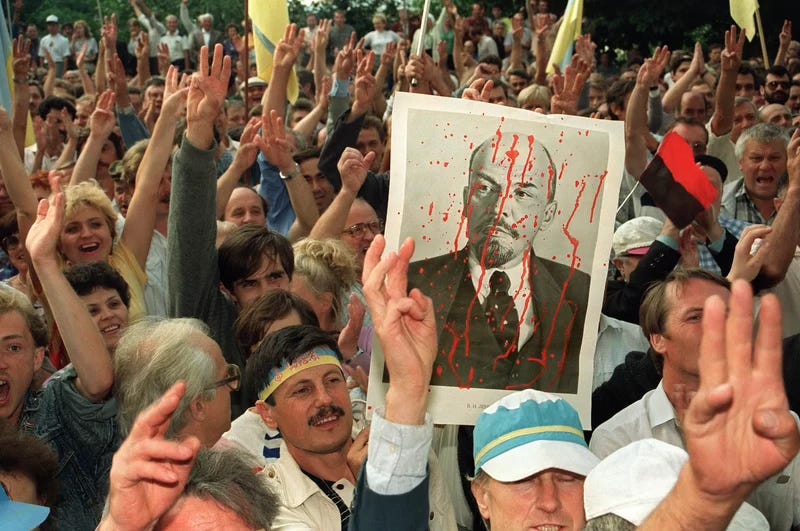
The story of corruption in Ukraine is long, intricate, and layered.
Its roots lie in the chaos that followed the collapse of the Soviet Union. In those turbulent years, the transition from state control to a free market economy took place without clear rules, protections, or transparency. That’s how the directors of public industries reinvented themselves as oligarchs—seizing entire sectors of the economy and turning their economic influence into unchecked political power.
In a short time, these men became the country’s de facto rulers. They controlled energy, steel, the media. They funded political parties, manipulated television networks, and wrote—and rewrote—laws to serve their own interests.
But something changed in 2014.
The Euromaidan Revolution wasn’t just a wave of street protests. It was the collective cry of a civil society demanding reform, transparency, and justice.
From that moment on—amid solemn promises and deep disappointments—important steps were taken: new institutions were established, such as NABU (the National Anti-Corruption Bureau), the High Anti-Corruption Court, and the NACP (National Agency on Corruption Prevention). For the first time, powerful and seemingly untouchable figures were investigated, charged, and eventually convicted.
And yet, the path has been anything but smooth.
The fight against corruption has been uneven, hampered by contradictory laws, overturned verdicts, and relentless political pressure. Every step forward seemed to come with a backlash, eroding public trust in the justice system and in state institutions.
Then came the war.
Russia’s invasion marked a turning point: on the one hand, it accelerated the drive for transparency, dismantling oligarchic empires and exposing scandals in military procurement. On the other hand, it opened new cracks, creating golden opportunities for fresh corruption—especially involving funds intended for defense and reconstruction.
And thankfully, the public hasn’t stood idly by.
The recent street protests against laws that undermine anti-corruption agencies speak to a citizenry that is more aware, more demanding—and finally, less willing to tolerate wrongdoing: vocal, angry, and mobilized.
Today, Ukraine faces a critical challenge.
It wants to join the European Union.
But to do so, it must prove that it respects the rule of law, strengthen its judiciary, and defend its anti-corruption institutions with resolve.
Brussels is breathing down its neck, watchdog-like, tying funds, aid, and political access to real, measurable progress.
Still, the road ahead remains bumpy.
Many citizens still see corruption as a deeply rooted, structural disease, and impunity as a lingering scourge. But compared to the past, something has changed: social tolerance for corrupt behavior is rapidly declining. Whistleblowing is on the rise. A number of high-profile scandals have hit ministers, generals, and long-entrenched oligarchs.
In this context, the fight against corruption is no longer just a domestic issue.
It’s a test of international credibility.
And it’s an essential condition for building a European future.
🇺🇦 Ukraine Is Not Ready—But Ukrainians Are
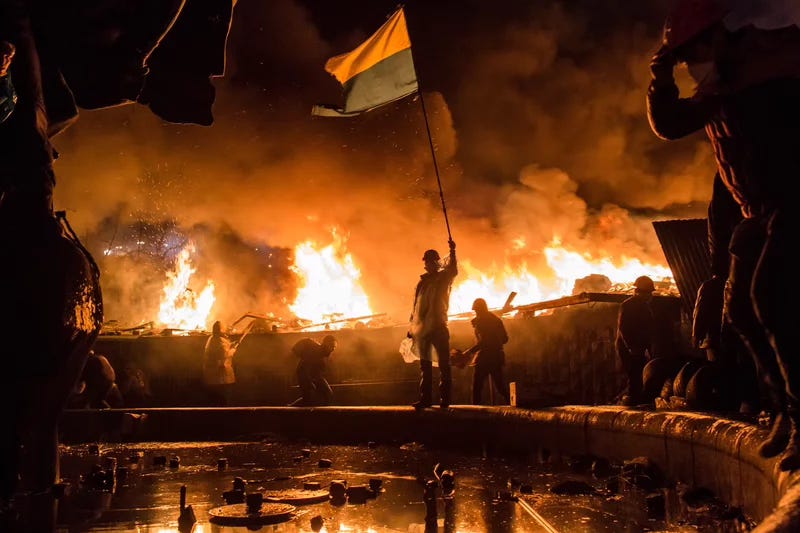
Anti-government protesters guard the perimeter of Independence Square, known as Maidan, in Kyiv on Feb. 19, 2014. Protesters were calling for the ouster of President Viktor Yanukovych over corruption and an abandoned trade agreement with the European Union. Brendan Hoffman/Getty Images
I’ll end this article with a truth that’s hard to accept, but impossible to ignore:
Ukraine, today, is not yet ready to join the European Union.
Its Soviet past still weighs on it like the entire Kremlin. Its institutions remain fragile. The mechanisms of the rule of law are incomplete. The fight against corruption is inconsistent.
The road to Brussels is still long—as long as the entire contact line with the Russians in the east.
And yet…
The Ukrainian people are ready.
Ready to choose, with clarity and courage, the right path.
Ready to sacrifice, to fight, to take a stand.
Ready—as they’ve once again shown in recent days—to take to the streets, to make their voices heard, to refuse to look away.
Those who protest under the threat of bombs, who cry out for freedom amid sirens and blackouts, who defy unjust laws in the middle of a war—they don’t do it out of convenience.
They do it because they truly believe in it.
The journey toward Western values didn’t begin today, nor will it end tomorrow.
It began in the blood of Euromaidan, when the police beat protestors and snipers fired into the crowds.
When an entire people were victims twice over—threatened from both East and West.
Victims of something bigger than themselves… Those who know, know.
We’re not ready to talk about that part—yet.
This path toward Westernization passed through armed resistance, and continues today in civil protest.
A people who have known darkness can recognize the light.
And they know how high the price is to reach it.
To those who had the strength to take to the streets, I say:
my deepest respect.
You are the vanguard.
You are living proof that even in a country still imprisoned by its past, consciousness can be free, the mind can be European, the soul can be democratic.
Healing is never linear.
Relapses are inevitable.
But you, today, have shown yourselves to be brave healers.
You are treating a weary body—one that resists the cure.
I’m rooting for you.
For those of you who raised your voices.
For those of you who chose not to remain silent.
For those of you who already know how to write with your actions what your Constitution may one day finally declare.
Your country is not Europe yet.
But when it is—and it will be—it will be because of you.
Per aspera ad astra. 🇺🇦🇪🇺