
Trump’s 28-Point Peace Plan for Ukraine: Opportunity or Deception?
Trump threatens Zelenskyy, then walks it all back.

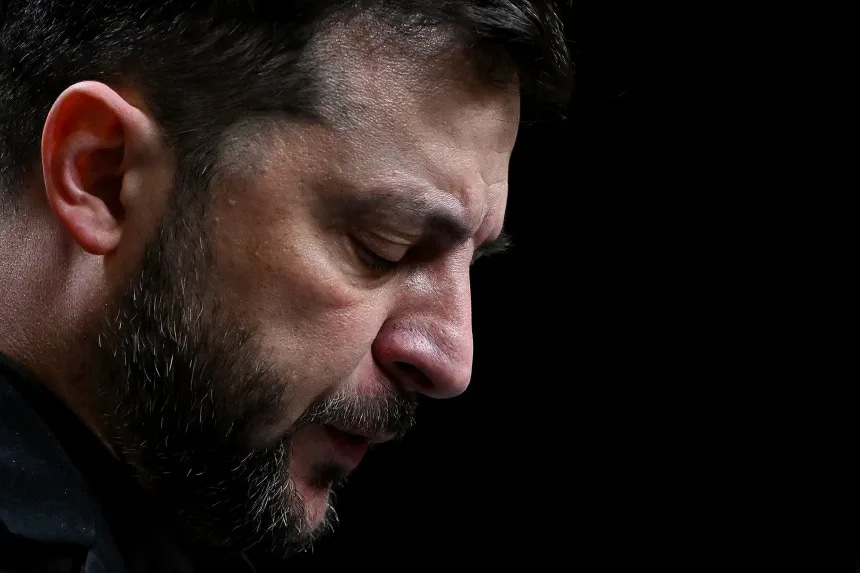
The first casualty when war comes is truth – Hiram Johnson
We’ve had time to get to know Donald Trump: a chaotic man, prone to changing his mind, contradicting himself, swallowing his own words only to restate them moments later with the same unshakeable confidence.
How can we approach such an unpredictable figure without falling into his communication traps?
Think of the fiasco surrounding tariffs, the media confusion he stirs up, the conflicting messages he pushes out almost daily. His voter base is split between nationalist impulses and isolationist instincts, yet he is amassing warships in the Caribbean Sea to apply pressure on Venezuela, creating confusion even among his staunchest supporters.
This is the same Trump who, back in August, shook the bloodstained hand of dictator Putin—and has now imposed harsh sanctions on Russian oil giants like Lukoil.
The same President Trump who once mocked and belittled Zelenskyy in the Oval Office is today contributing to Europe’s war effort by selling weapons to allies and providing intelligence to the Ukrainian people.
How do you evaluate a man who behaves like this?
a genius, a strategist, a master communicator;
a confused, chaotic man, likely lacking any coherent strategy, improvising from moment to moment.
Why does it matter?
Because if we fail to understand the game Trump is playing, we will keep falling into his media dynamics—carefully engineered to manipulate perceptions and steer emotions.
In a geopolitical environment like this, the last thing we want is to be manipulated… right?
Do you remember when he announced he had deployed nuclear submarines near Russia?

A theatrical move—yet another jab aimed at those who react impulsively, unaware that such submarines are, by definition, always within striking distance. An empty announcement, but meticulously crafted to make noise.
This new peace plan may be exactly the same: yet another stunt, another farce designed to draw attention to himself rather than genuinely shift strategic balances.
If Trump often appears ill-suited—at least in terms of communication—Putin is anything but: a man of hardened resolve, a Dictator with a capital D, cold, controlled, and ruthless.
A bloodstained leader like that would never indulge Trump’s theatrics.
And Ukraine?
How much longer must it remain the sacrificial lamb in the hands of countries playing games with the fate of a third nation?
The “28-Point Plan”: Contradictions and Incompetence
Much has been said in recent days about this 28-point plan. I preferred to wait before speaking publicly, because I sensed it would reveal itself—once again—as yet another chapter in the long book of farces.
I’ll spare you a full paragraph explaining that this plan was, in all likelihood, originally written in Russian. If you want to dig deeper, you can do so here.
What I do want to focus on is the inadequacy of Witcoff, who in recent months has repeatedly shown himself not only unprepared but profoundly incompetent. This man has done nothing more than send home a document largely drafted by the Russians.
Is this man serving American interests?
The question is now unavoidable.
Trump likely hasn’t even read it; yet he didn’t hesitate to threaten Zelenskyy.
American leadership today has sunk to a dramatically low level. I have never hidden my concerns regarding Russia. I am Italian, I live in Europe, and yet I must admit that—although Trump remains a charismatic president—his closest circle appears shockingly mediocre, and this concerns me perhaps even more than the Russian threat.
Fortunately for us, the deep state exists: the structure that holds together the nation and the entire American empire. On many issues, Trump is constrained—and that is a good thing. At a moment like this, we cannot afford lone men at the helm. Not even the wisest, most educated, most competent individual could single-handedly guide a country and an alliance out of this stormy sea.
Back to the 28-point plan: it contradicts itself repeatedly. It claims that Ukraine cannot join NATO, yet asserts that an attack on Ukrainian territory could trigger Article 5 of the Atlantic Alliance.
How can Article 5 be invoked for a country NATO itself would not recognize as a member?
The same document envisions Ukraine losing the Donbas while simultaneously joining the European Union. For the record, the European Union provides—should a member state face military aggression—a clearer and more forceful collective response than that foreseen by NATO’s Article 5.
Contradictory, isn’t it?
This agreement has been rejected by everyone: by Zelenskyy, who—mistakenly—responded with a national address that exposes him to Russian media attacks; by the Duma, with Putin declaring the document acceptable only as a “starting point”; by the European Union, which unanimously sent it straight back to the sender.
Even Trump has admitted it is “negotiable,” indirectly acknowledging that he himself doesn’t really like it.
In such chaos, we MUST learn to distinguish signal from noise.
Now more than ever, we MUST learn to separate what matters from what merely distracts.
This point is crucial to me: we can only make decisions based on what we know, but we must be able to discern accurate information from misleading noise.
Donald Trump builds much of his communication on noise: constant declarations, then retractions, then reaffirmations—an endless stream where noise drowns out the signal. Every day the world is overwhelmed by this tide of contradictions.
This peace plan is no exception: it is nothing but noise—yet another distraction pulling us away from what truly matters when trying to understand the war in Ukraine.
And this is where we must ask ourselves a crucial question:
What is truly important to understand today…?
The Signal: the Battlefield and the Strategic Interests
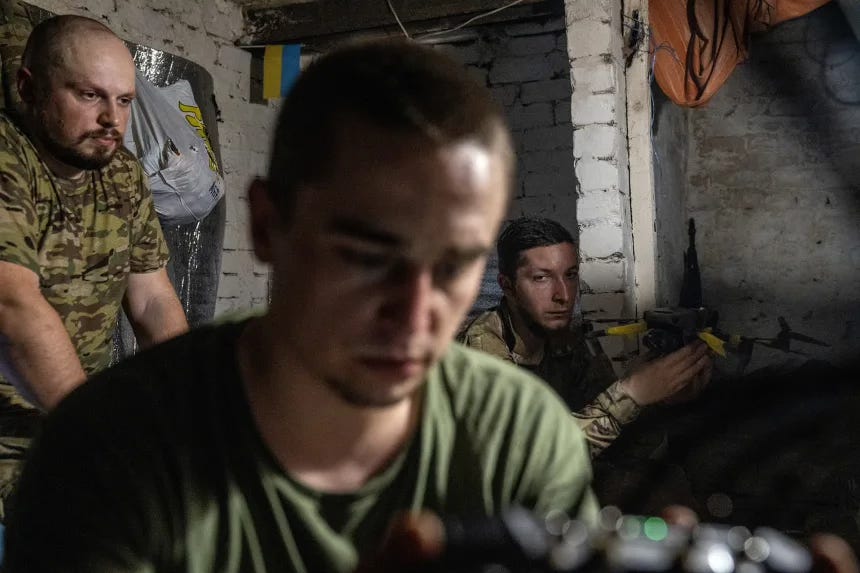
The essential truth is that Ukraine is fighting its war of independence—a war that, if lost, would mean surrendering its sovereignty. Russia attempted a coup in the early weeks of the conflict; once that failed, it reframed the war as a seemingly technical matter: Is the Donbas Russian or Ukrainian—perhaps simply Russian-speaking?
But we all know the reality: Putin is not interested in the Donbas itself. What he fears is losing influence over yet another Eastern European state—seeing another country drift away from the Russian orbit toward the Western world… or more accurately, the American one.
Seeing yet another NATO base, or worse still, another American base on European soil. Bases that already fill Italy, Germany, Romania, and beyond.
In this, Russia has already failed. It did not take Kyiv, it permanently damaged its relationship with the Ukrainian people—who today hold a deep and intense russophobia—and it watched Finland enter NATO.
So where, exactly, is this much-touted strategic Russian victory?
If Russia appears to be winning in the media—helped also by the rhetorical fog stirred up by Trump—strategically it has already lost its key objectives. Even if slowly, it advances in the Donbas.
Today this war has become a meat grinder: a place of death where young Ukrainians and young Russians witness their final dawns and their final sunsets. The dictator Putin is forcing his own citizens to die on the front line and is steering the country toward mounting economic strain, all sacrificed on the altar of a promise he cannot afford to break:
“The Russian-speaking people of the Donbas must be reunited with us.”
That is what he said in that cursed address to the nation in February 2022.
This is the media justification—the repeated promise to the populace—even though we now know that the war never truly began for that reason.
There is only one question left to understand:
When will this war end?
When will the suffering stop?
I have my own idea, and I believe that Ukraine—consciously or not—is trying not to let this war end. Ukrainians know that the Russians want to capture what remains of the Donbas, and they are trying to make that advance as costly as possible—in human lives and economic resources.

I believe Ukrainians know that those territories will, sooner or later, be lost; they know that a peace deal will come because Putin must be able to say, at home, that he fulfilled his promise. But they also know that, by then, Russia will be in serious economic and military difficulty, while Ukraine will finally be able to begin a path of reconstruction and rebirth: mutilated, yes, with less territory—but free, independent, and—why not—inside the European Union.
I believe the American deep state is aiming in the same direction. I believe they too intend to follow this line—in fact, perhaps things have been moving toward this outcome for years.
The United States wants to weaken Russia, but not break it completely—not trigger the secession of republics and oblasts, as happened after the fall of the Soviet Union.
What would happen if such a heterogeneous and unstable country splintered, with its nuclear warheads dispersed among unpredictable local governors?
In this scenario, paradoxically, it is considered the “lesser evil” to keep a killer like Putin in power rather than risk widespread atomic chaos. The United States is, in practice, regulating the flow of aid to Ukraine to either facilitate or slow down the Russian advance according to its strategic interests. It is Washington, through those aid packages, that determines how quickly or slowly Moscow’s army can move—weakening it, but without risking a total collapse.
And as always, the Americans have decided that the economic burden should fall on the Europeans.
Russia is a threat above all to us, European citizens, and so it is deemed right that we pay the highest price. Just as Israel bears the greater cost of dealing with a troublesome adversary like Iran.
In this grim power game, Ukrainians die, Europeans pay, and Russians collapse.
It is essential to remember that Putin started this war—and that Ukrainians deserve to be defended and supported, even though they are perfectly aware that they are, at the same time, being used for strategic purposes far larger than themselves.
Dear readers, I invite all of us—every day—to ask ourselves what is noise and what is signal.
This peace plan is noise: I have not spent much ink analyzing it because it is contradictory, fragile, incoherent, and already rejected by every actor involved. It took only a few days for it to fade into oblivion.
Our newspapers contribute to this pollution of public discourse.
Donald Trump contributes to this media confusion.
And we are the ones who pay the price.
You and I alike.
Per aspera ad astra.
Who I Am, What I Write About, And what you can learn

Hello, and thank you for stopping by my profile.