
Trump Arms Ukraine: The War Goes On—And It Works in Our Favor. But for How Long?
Trump takes center stage. Behind the scenes, the West wins. But every advantage comes at a cost—and that cost could be devastating.

You know, the more time goes by, the more I realize just how incredible the power of newspapers really is.
They may look like nothing more than websites or sheets of paper.
And yet they manage to manipulate us, to convince us of absolutely anything.
Every single day.
And no one seems to really notice.
Or rather—we know that’s how it works, but we’d rather not think about it too much.
It’s a bit like smoking: deep down, a smoker knows it’s bad, but just can’t quit. They’re addicted. They need to smoke.
Just like that smoker, we open the paper and read things like:
Americans no longer want to supply Ukraine with weapons.
We learn that Trump promises to end the war in a single day and that he clashed with Zelenskyy in the Oval Office.
And once again, like that smoker, we fall for it.
We buy the whole story.
The trick?
Reporting true facts, then interpreting them however you want.
Manipulation hides right there, in plain sight.
And yet all of us—at least once—have asked ourselves:
“What if it’s all a show?”
…as we lit yet another cigarette, this time a metaphorical one.
But the thing is, no performance can go on forever.
Eventually, the curtain falls.
Nine months after the U.S. elections, the curtain fell—ending the illusion that Trump was the “peaceful president” ready to hand Ukraine over to Russia.
And the truth stood revealed: This war is hugely benefiting the Americans and Europeans. (at Ukraine’s expense)
So yes, it's in our best interest that it continues.
Our gain is intertwined with Ukraine’s: Kyiv wants to reclaim lost territory, but above all, it no longer wants to be under Moscow’s thumb.
It doesn’t want to become the next Belarus.
In this intricate play of roles, Trump sold a dream: ending the war in just a few days.
But Trump is an old fox—he knew exactly what Biden and his team were doing. He knew that the war had to go on.
So, after winning the election, he spent months “negotiating” with Putin.
He staged Oval Office spats with Zelenskyy, in clips that went viral and reached millions of Americans.
A clear message to his base:
“I’m really trying to stop this war.”
Trump knew that many Americans couldn’t stand Zelenskyy.
And he gave them what they wanted.
But like I said, Trump’s no fool.
He knows this war is draining the Russian economy.
He knows Europe is pouring billions into rearmament and into crippling Moscow’s economy.
He knows that, in a potential future conflict with China, Russia won’t be able to help—and that’s the whole point.
And he knows that all of this plays right into America's hands.
So after months of theater, a light appears at the end of the tunnel: Trump starts getting tired of Putin.
He realizes that the Ukrainians just want to defend themselves.
So he arms them.
Or rather—he doesn’t arm them directly.
He gets the Europeans to buy the weapons.
Because—and here’s the other paradox—his voters, in addition to hating Ukrainians, also hate Europeans.
(Being a politician, at times, must feel like walking a tightrope: doing everything and its opposite, while selling it all in the most appealing way to your voters.)
Where Is This Story Headed?
Many of the “cigarette smokers”—to stick with the metaphor—were convinced that 2025 would be the year the conflict ends.
But, reluctantly, I have to admit: I find that hard to believe.
Sure, everything can change overnight.
But today, I just don’t see how this war could realistically end anytime soon.
The Russians are in an increasingly uncomfortable position: sanctions piling up, growing isolation, half the world looking at them with hostility.
And in the meantime, Zelenskyy is still standing.
Kyiv holds.
Putin didn’t want Ukraine to join NATO?
No problem: it’s NATO that has entered Ukraine.
To be precise, that process had already begun well before the war broke out.
And that very dynamic is one of the key reasons behind the invasion.
But ever since Western military aid began flowing into Kyiv, NATO’s presence has become a reality.
Putin wanted just one thing: to pull Ukraine away from the West.
He’s getting the exact opposite.
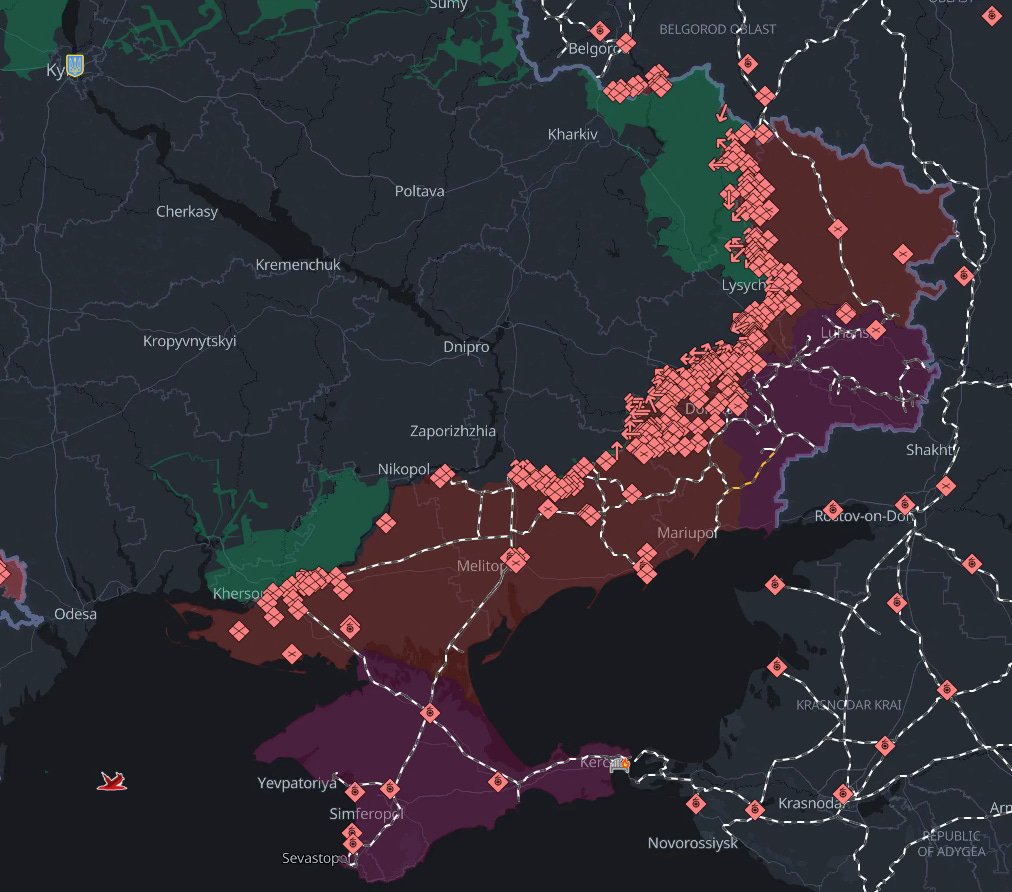
Yet we’re told, “the Russians are advancing.”
Soon, maybe, they’ll manage to take Pokrovs'k.
It’s only taken them “just” a year.
Yes, the Russians are advancing.
And the Ukrainians are losing ground.
And that might continue for quite some time.
What should we expect?
Unfortunately, I fear nothing new.
Trump’s actual strategy remains unclear.
But if he continues down this current path, the Ukrainians will keep resisting, slowly draining Russia’s resources, armed by the Americans and funded by the Europeans.
Until a breaking point is reached.
It doesn’t matter whose breaking point—it only matters that Moscow gets worn down, remember?
If the strategy shifts, however, then Kyiv might start receiving even more support: more sophisticated weapons, better intelligence.
And at that point, Ukraine wouldn’t just be holding the line anymore.
It might start to force Russian troops to retreat, to fall back.
In the best-case scenario, it could even reclaim some of the lost territories.
But rather than a “best-case scenario,” that still feels far too much like a fairy tale for now.
In the worst-case scenario, Ukraine will never manage to retake the occupied regions.
Russia will eventually consolidate its control over 3, 4, maybe 5 oblasts, just enough to tell its domestic audience that it won.
And then, perhaps, a truce would come.
A wounded Ukraine, with fewer territories—but even more integrated with the US, the EU, and NATO.
This, personally, is the scenario I find most likely.
For now, all we can do is watch.
Wait to see which strategy Trump will actually pursue.
And how the Ukrainians will respond if Western support ramps up even further.
Fear and Feelings
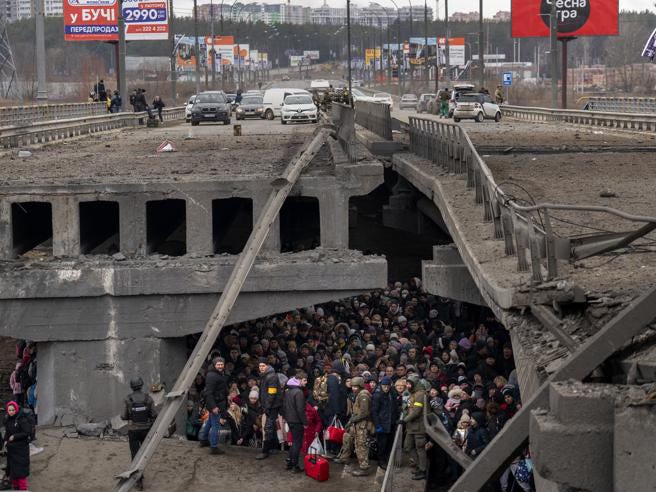
This war weighs on me.
Every single day.
I don’t live in Tallinn or Kharkiv. I live in Italy.
Safe—or at least that’s what we like to believe.
Surrounded by NATO bases and U.S. forces, protected by stable borders and the comforting illusion of distance.
But I can’t shake a single image from my mind: that of a Lithuanian kid waking up every morning wondering if this will be the last day of peace.
Living in the Baltics these days must feel... strange.
What does it feel like?
How can one not live with anxiety stitched into their skin?
And yet, it’s been almost four years that this conflict has been with us.
It surrounds us—even when we pretend not to notice.
And ever since then, I’ve never stopped asking myself:
What will I do if the war expands? What if the front moves closer? What will I do… when it comes for us?
For years I’ve been gathering sources.
Studying dynamics, scenarios, geopolitical shifts.
Trying to read between the lines of public statements, to understand where we’re really heading.
But more than anything, I prepare.
I study how to access my money even if it gets frozen by sanctions, controls, or banking restrictions.
I research how to secure myself in another country, making the most of international residencies, possible second passports, and building networks, skills, and mental flexibility.
Because in unstable times, it’s not the strongest who survives.
It’s the one who adapts the fastest.
I’m planning to write articles on this topic—small things that, when combined, can make a real difference for ourselves and the loved ones we care about. Subscribe if you don’t want to miss them and want to learn how to feel safer and more at ease. With the hope, of course, that you’ll never actually need to put these precautions into practice.
We’ve talked about Trump and his two-faced game.
We’ve seen how the war has become a strategic advantage for the West: Russia is bleeding, Europe is rearming, alliances are strengthening.
Everything seems to be going our way.
But how far can we push it?
That’s the question that haunts me.
Because yes, we are benefiting.
Yes, we’re gaining time, power, influence.
But the longer the war drags on, the higher the stakes become.
And when you stretch a rope too far... it eventually snaps.
And if it does, the consequences could be catastrophic.
Let’s not forget: the main strategic goal of this war is to strip Russia of the very resources it could one day use to support China in a future, much larger conflict. To drain the money they might otherwise invest in that scenario.
A conflict that spills into another NATO country.
An escalation spinning out of control.
A miscalculation. One provocation too many.
An economic or financial crisis overlapping with a military one.
This isn’t political science fiction.
This is history.
It’s already happened.
And that’s exactly why we can’t afford to look away.
We live in an age where closing your eyes is the easiest option.
But it’s also the most dangerous.
Because the real question today is not whether the war will reach us.
But when.
My articles don’t just explore risks—and soon, solutions too.
They’re not just a way to stay informed.
They’re a space where you learn to read a world in flux, and more importantly, how not to be swept away by it.
Be ready. Because when history arrives, it doesn’t knock—and it leaves behind those who failed to read the signs.
Per aspera ad astra.
My impression is that while there is no shortage of people in the US who are thinking quite strategically and seeking to influence Trump accordingly (overall those who have been significantly successful at this so far are pursuing objectives which are quite unpalatable from my perspective), Trump himself doesn’t have a strategy. If that impression is correct, then to pretend otherwise is to engage in sanewashing.