
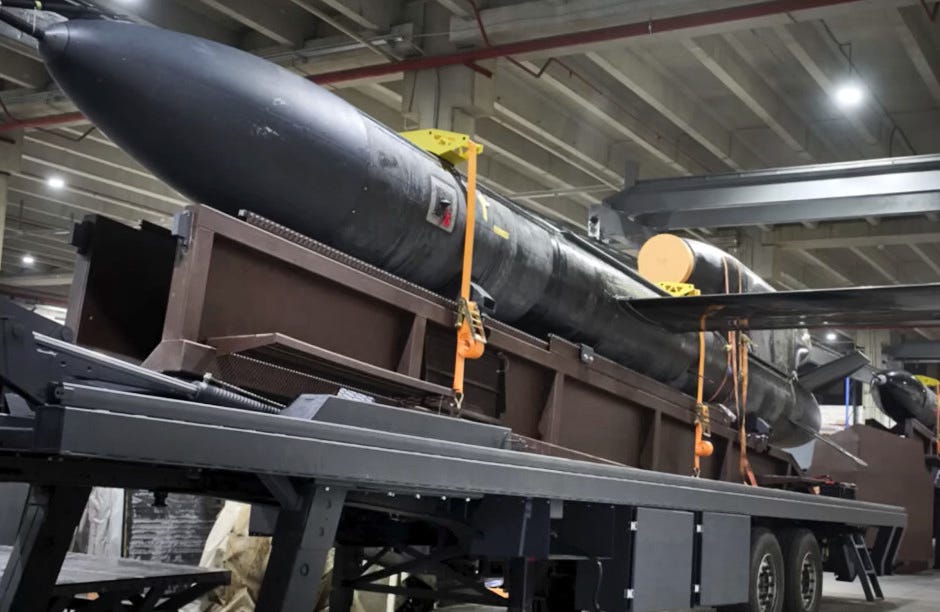
About fifteen days ago, a new Ukrainian weapon was presented — more or less officially: a cruise missile — or perhaps a drone, as we’ll see later — with characteristics that calling them “astonishing” would be an understatement.
We know its dimensions, weight, explosive payload, and range. Not only that: photographic and video evidence shows the vehicle in action, as well as the factory where it was allegedly produced. Or perhaps, more accurately, assembled.
Ukrainian authorities have claimed they intend to produce several units per day. Mind-boggling numbers for a weapon that already has seemingly science-fiction capabilities. But does it really add up?
I chose to wait two weeks before discussing it. Why? Because I wanted to look past the announcement, dig into the contradictions, and observe international reactions. Here’s a heads-up: nothing is as it seems.
From the very first days, it was noticeable how shamelessly this missile echoes the infamous Nazi V1. But there’s more: the design appears almost identical, in shape, technical features, and even in name, to a system developed by a well-known defense company specializing in drones. Coincidence?
According to some sources, the British reportedly contributed significantly to its development. Yet the official narrative claims the device is entirely Ukrainian.
Now, let’s think this through: what would you say if I told you that a cruise missile capable of carrying 1,000 kilograms of explosives over 3,000 kilometers is not in the arsenals of either the United States or Russia? What if I told you that Kyiv claims to have developed a weapon that even America — one of the most technologically advanced countries in the world — does not possess? Would you really believe it?
So what is true? Am I right to be skeptical, or am I just a catastrophist?
After fifteen days of waiting, today I want to clarify and explain why this device — the so-called Flamingo — in my view, may not be a cruise missile at all, but rather a mass distraction weapon.
A Brief Technical Explanation
Let’s start with what we already know. In recent days, this new missile has been discussed everywhere, and if you’ve been following the story, you probably know some of its main characteristics.
The Flamingo has been presented as a cruise missile. But what does that actually mean?
Cruise missiles are a specific type of weapon that should be distinguished from ballistic missiles. Before diving deeper, however, it’s useful to clarify a fundamental point: what is the difference between a rocket and a missile?
A rocket, in its essence, works similarly to a cannonball. Once launched, it cannot change its trajectory: it lacks guidance systems or movable fins. This means the target must be defined with precision at the moment of launch, just as was the case centuries ago with traditional artillery.
Missiles, on the other hand, are equipped with guidance systems — for example, GPS — and fins that allow course corrections in flight, much like airplanes do. This is not a minor detail: this capability makes them vastly more precise and effective. Notably, in the videos released so far, the Flamingo appears to be equipped with these movable fins.
Now we arrive at the crucial point: what is the difference between a ballistic missile and a cruise missile?
This distinction is decisive because it concerns not only the trajectories but also — and above all — the strategic purposes for which the two types of missiles are employed.
Ballistic missiles, as the name suggests, follow a ballistic trajectory, meaning a path that closely resembles that of a cannonball. Imagine a dome that rises, reaches its apex, and then falls toward the target: this is the underlying logic of their operation.
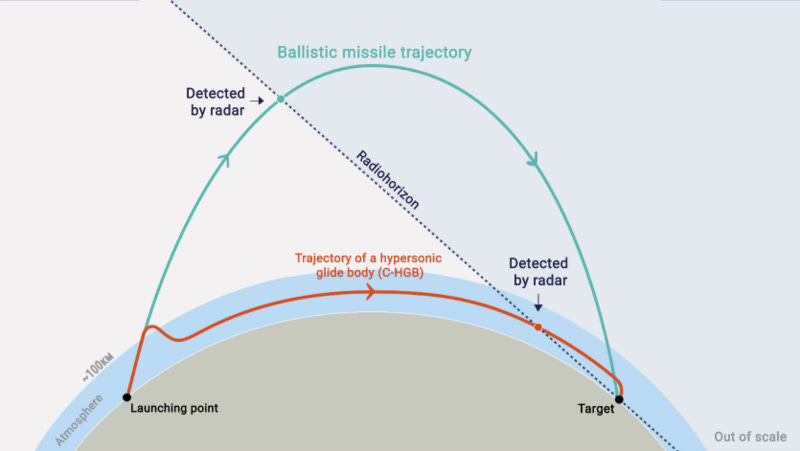
As we can see from this image, the blue line represents the trajectory of a ballistic missile, while the red line depicts the trajectory of a cruise missile.
Cruise missiles tend to follow the contours of the terrain, remaining within the atmosphere. Ballistic missiles, on the other hand, exit the Earth’s atmosphere and spend most of their “journey” in space.
These two types of missiles come with different advantages and disadvantages and must be employed strategically depending on the objectives to be achieved.
But what are the most significant operational differences?
If the target is at a long distance, the ballistic missile becomes the preferred choice. This is because, in space, the absence of air eliminates aerodynamic resistance, drastically reducing fuel consumption and allowing the missile to cover enormous distances.
Conversely, to strike closer targets, a cruise missile proves far more effective: flying at low altitude and following the terrain, it is less visible to enemy radar and thus has a higher chance of reaching the target without being intercepted.
Isn’t it fascinating to note that the choice of weapon doesn’t depend solely on power, but on a sophisticated calculation of distance, context, and strategic objectives?
Characteristics of the Flamingo:
I hope the previous explanation wasn’t too technical, because it will now be extremely useful in understanding the absurd characteristics of the Flamingo.
As we know, this missile is a true colossus: about 13 meters long, weighing 6,000 kilograms, and reportedly capable of carrying over 1,100 kg of explosives up to 3,000 kilometers. Impressive numbers — at least on paper.
Let’s compare it with one of the most advanced and feared missiles in the world: the American Tomahawk. The Tomahawk weighs around 1,600 kg, carries a 450 kg warhead, and has a range of 1,600 km.
Do you see the disproportion? The Tomahawk weighs almost four times less, yet its explosive capacity is less than half, while its range is about half that of the Flamingo. How is that possible? Would the Americans — pioneers of missile technology — really have overlooked such potential?
The answer is clear: it’s not incompetence, but logic. Cruise missiles, after all, fly entirely within the atmosphere and must constantly overcome air resistance. This leads to enormous fuel consumption: the farther they need to go, the more fuel is required. More fuel means gigantic tanks, which in turn means larger and heavier missiles.
This is why the Flamingo is so massive: it is nothing more than the direct consequence of a questionable design choice.
The United States doesn’t have a cruise missile with such characteristics for a very simple reason: it wouldn’t make sense to use one. For distances of 3,000 km, it is far more rational to employ a ballistic missile, which is lighter, more efficient, and already proven.
So, the real question is: why would Ukraine develop a device so disproportionate, when better and widely available alternatives already exist?
Commentary and Inconsistencies of the Flamingo:
There are many things about the Flamingo that don’t add up. But the most striking issue, as anticipated, concerns the role it is supposedly meant to play — a task that, by definition, is not suited for cruise missiles.
Attention: this doesn’t mean it’s physically impossible to build such a device. It’s entirely plausible that the Ukrainians have indeed developed a missile with these characteristics. What doesn’t hold up, however, is the economic sustainability.
A cruise missile of this size and capability would be incredibly expensive to produce, especially for a country with a weakened economy, battered by years of war. Making the story even harder to believe is the declared figure: Kyiv reportedly aims to produce around seven units per day before winter. Given the costs, this goal sounds more like science fiction than reality.
I certainly don’t claim to have the ultimate truth, nor do I want to arrogantly assert that the Flamingo doesn’t exist. But I think it’s legitimate to ask questions, analyze the data, and reflect together on what might really be behind this story.
Here are some possible considerations:
The Ukrainians, lacking the technology to build ballistic missiles today, may have opted for a cruise missile, even though it is unsuitable as a long-range weapon.
It’s possible they have indeed built such a device, but cannot sustain mass production due to exorbitant costs.
The data on range and payload might be misleading or contradictory: the Flamingo may reach 3,000 km, but not while carrying 1,100 kg of explosives; or it can carry that payload, but not over that distance.
Mass production could exist, but only by scaling down the specifications: shorter range and smaller payload, reducing engine costs and lowering the unit price.
In short, however you look at it, the blanket is too short: somewhere, a lie must have been told.
It is impossible for the Ukrainians to produce, on an industrial scale, an extremely expensive weapon that travels extremely far and carries such a massive payload.
Yes, and what next? Does it go to the moon? Make your coffee in the morning? Drive the kids to school?
An interesting detail comes from one of the most famous videos depicting the Flamingo. In those images, the missile is compared to a Shahed, the Iranian drone widely used by the Russian army. But drones and cruise missiles only have one thing in common: low-altitude flight. Can we really consider this comparison sensible?
If that were the case, the Flamingo should be interpreted not as a strategic long-range weapon, but as an advanced drone: useful for striking nearby targets, with reduced explosive loads, lower costs, and more realistic mass production.
Ultimately, today there is only one certainty: we have many questions, but no clear answers yet.
What if the Ukrainians… Are Playing Us?

At this point, the real question is no longer whether the Flamingo truly exists in the miraculous form we are told about, but why this narrative exists. Why would a country devastated by war, with limited resources and constant reliance on external aid, invest energy, time, and money in a weapon so disproportionate, so inefficient, and ultimately, so unbelievable?
Perhaps the secret isn’t in the missile itself, but in the story being built around it. It wouldn’t be the first time that propaganda is used as a weapon in a conflict. Creating the myth of a revolutionary device captures the world’s attention, sparks debates, and fuels expectations. Meanwhile, what happens behind the scenes?
Imagine analysts, journalists, governments, and the public focused on the Flamingo, calculating weights, measurements, and range. Everyone absorbed in dismantling or defending numbers that may not even exist, while elsewhere — away from the spotlight — something much bigger could be taking shape, something that must remain unseen. A strategy, a technology, a plan hidden precisely because the Flamingo distracts us.
And what if this is the real weapon? Not the missile itself, but its legend. A psychological weapon, a smokescreen that leaves no craters, but diverts attention, shifts focus, and changes the debate. Isn’t it ironic? The most talked-about device of the moment might never explode, yet its purpose would already be fulfilled: keeping us occupied elsewhere.
So let’s think carefully: those who support Ukraine should be the first to talk about the Flamingo, to share its images, to praise it, to turn it into continuous news. Because the more it’s discussed, the more perfect it becomes as a screen hiding what really matters.
The conclusion is unsettling: the Flamingo may not be a weapon of war, but a weapon of mass distraction. And if that’s the case, the real question is no longer “how much explosive does it carry?” or “what distance can it cover?” but rather: while we are watching the Flamingo, what is happening in the shadows?
And perhaps, right there, far from cameras and headlines, the decisive move is being prepared.
Remember the advance in Kursk last summer? That happened in silence; there can be no warning. If you have an ace up your sleeve, you don’t broadcast it to the world. If you have a miraculous weapon like the Flamingo, you keep it to yourself and use it quietly, without much fanfare.
In any case, regardless of the truth, I hope this Flamingo works — whether to explode or to distract — and I hope the Ukrainians can make the most of it.
Stay alert, don’t get carried away by euphoria.
Per aspera ad astra.
Look me up on Substack, Thread, and X. → LINK