
There are moments in a war that mark a clear before and after.
What happened at several Russian military airbases a couple of days ago falls squarely into that category.
In my previous articles, I’ve often analyzed how the ongoing conflict is, in many ways, playing to the advantage of Western countries.
I stated it from the very first piece I wrote: the longer this war drags on, the more the West stands to gain.
But today, we’re facing something different.
A turning point.
Perhaps the most delicate one so far.
Here’s the news: Ukrainian forces managed to destroy around 10 Russian strategic bombers.
This wasn’t a symbolic gesture.
It was a direct strike at one of the most sensitive nerves of Russia’s deterrent power: its strategic air force.
And according to the Russian Federation’s nuclear doctrine, an attack on its nuclear capabilities — even potential ones — is enough to justify a nuclear response.
In other words: never since the beginning of this war have we come this close to the edge of a possible nuclear escalation.
But it won’t happen.
Not now.
Paradoxically, an escalation on that level would end up playing into Ukraine’s hands.
Because the world would be left speechless, shocked by the images — casting Ukraine even more clearly as the victimin the eyes of global opinion.
And Vladimir Putin, for all his contradictions, is no fool.
I know — I’ve put a lot on the table.
Now let’s start by breaking down the event, and then we’ll unpack what it means
Before explaining why this operation is both impressive and yet ultimately pointless, I want to thank you for clicking on this article.
If you appreciate my work, I invite you to subscribe — it’s free.
My perspectives are often blocked or censored elsewhere, but here I have the freedom to speak without filters.
Your support allows me to keep telling the stories others choose to ignore.
Thank you, truly.
Let’s do this the professional way: we start with the facts, then we analyze.
On June 1st, 2025, several trucks approached five major military airbases in Russia.
The drivers said they had no idea what they were transporting, convinced they were simply carrying out a routine delivery.
It’s likely they were deceived by the Ukrainians.
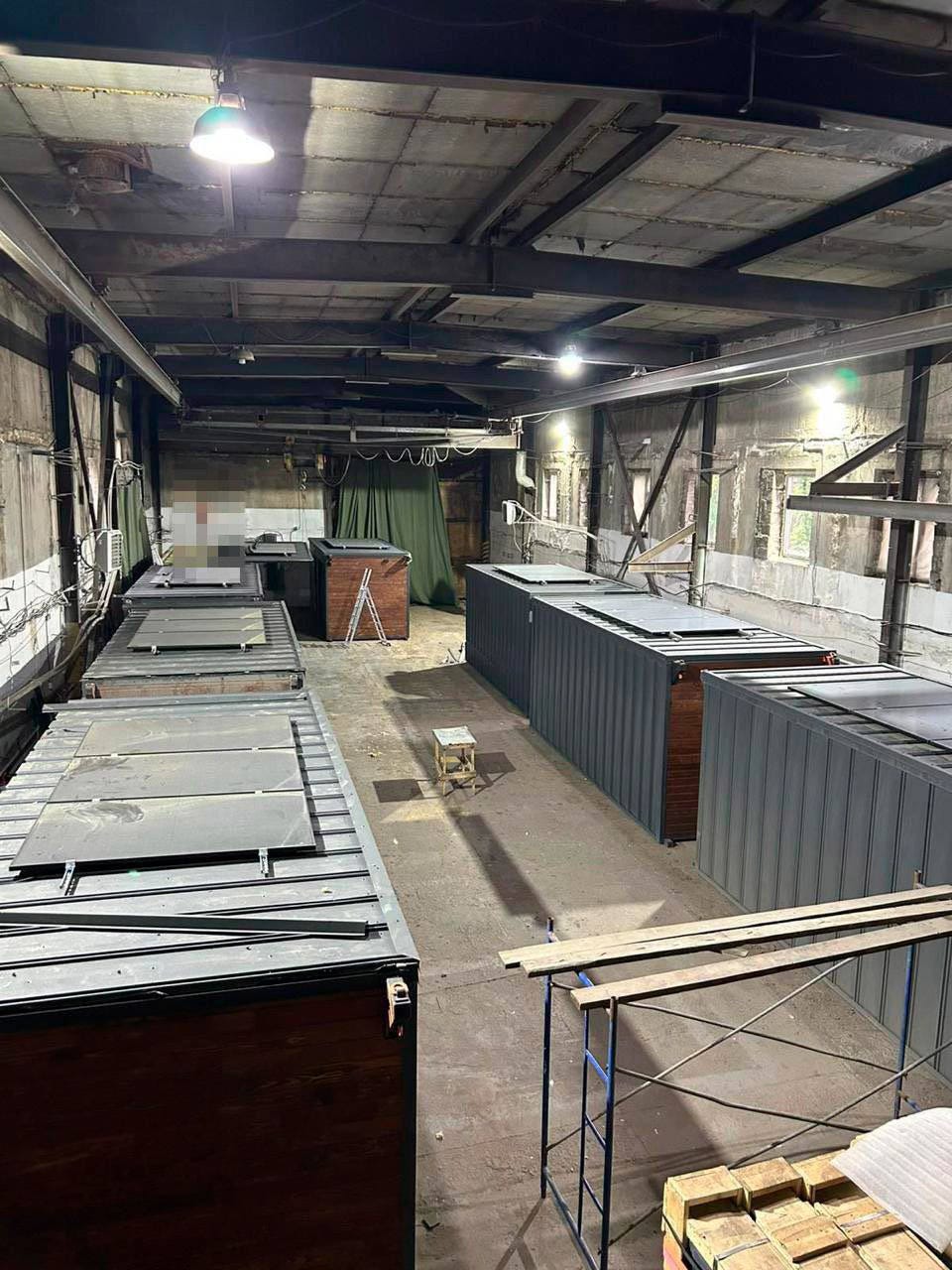
In this image, we see several containers parked inside what appears to be a warehouse — or perhaps a large garage.
These are the very same containers that were later loaded onto trucks and driven by unsuspecting drivers to the vicinity of the airbases.
But these weren’t ordinary containers: they had been modified and featured a hidden structure — a sort of “double roof.”
In the upper section, there was a concealed compartment housing small remote-controlled drones, each equipped with explosive charges.
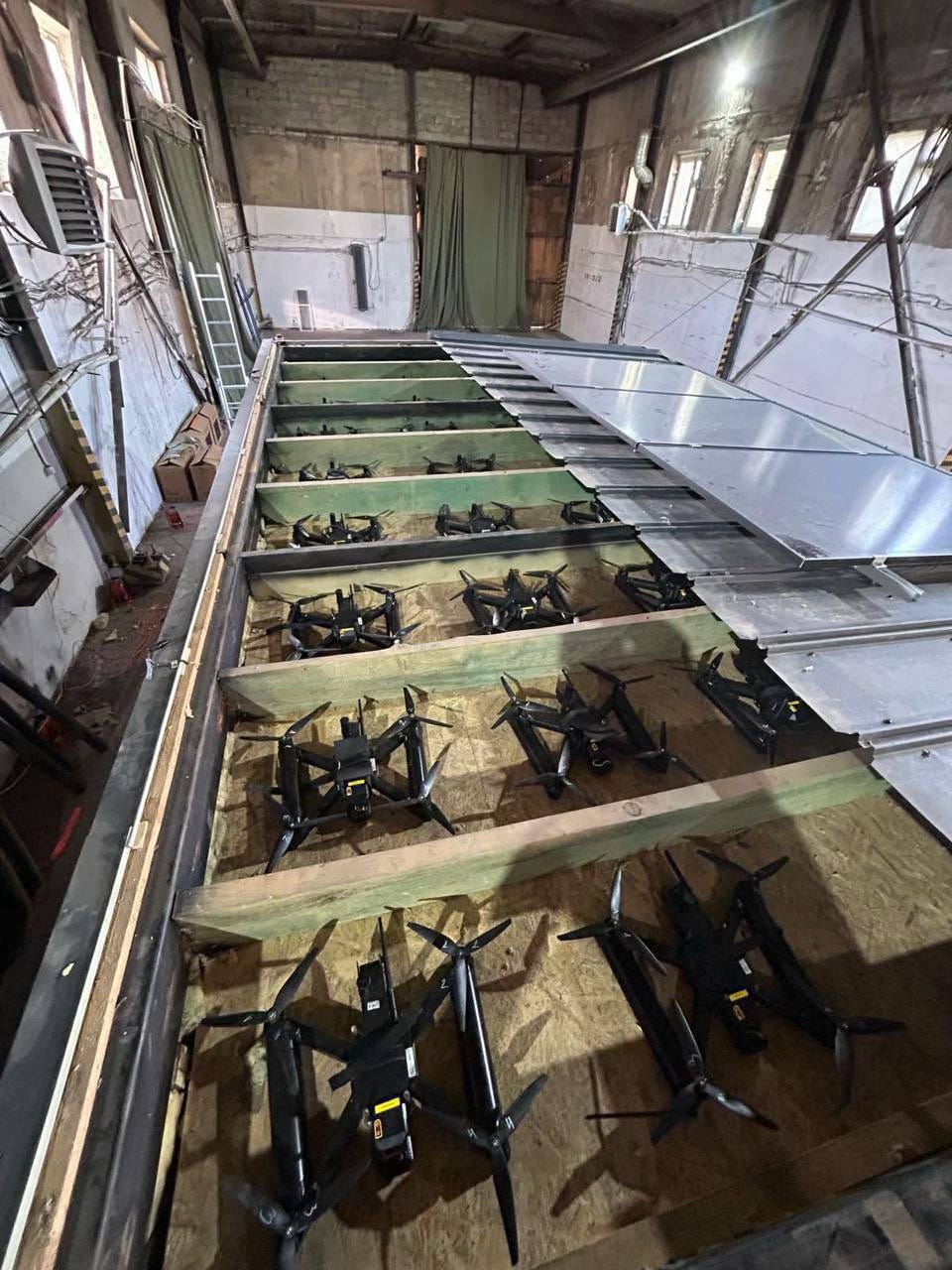
In this image, we can see one of the containers with its roof open, revealing several drones inside.
Once the roof was opened, the drones began to take off and fly over the airbases.
In the video, you can clearly see the same containers we mentioned earlier: from one of them, a drone is seen taking off and heading straight toward the airbase.
Lined up side by side were several strategic bombers — aircraft that are absolutely essential to the Russian air force.
To understand their importance, it’s enough to know that for decades these planes have represented a constant threat to all of Europe.
They’re capable of carrying nuclear warheads and are regularly used for bombing missions over Ukraine — albeit with conventional weapons.
Back to the drones: these small flying devices specifically targeted those planes, hitting them and triggering devastating fires.
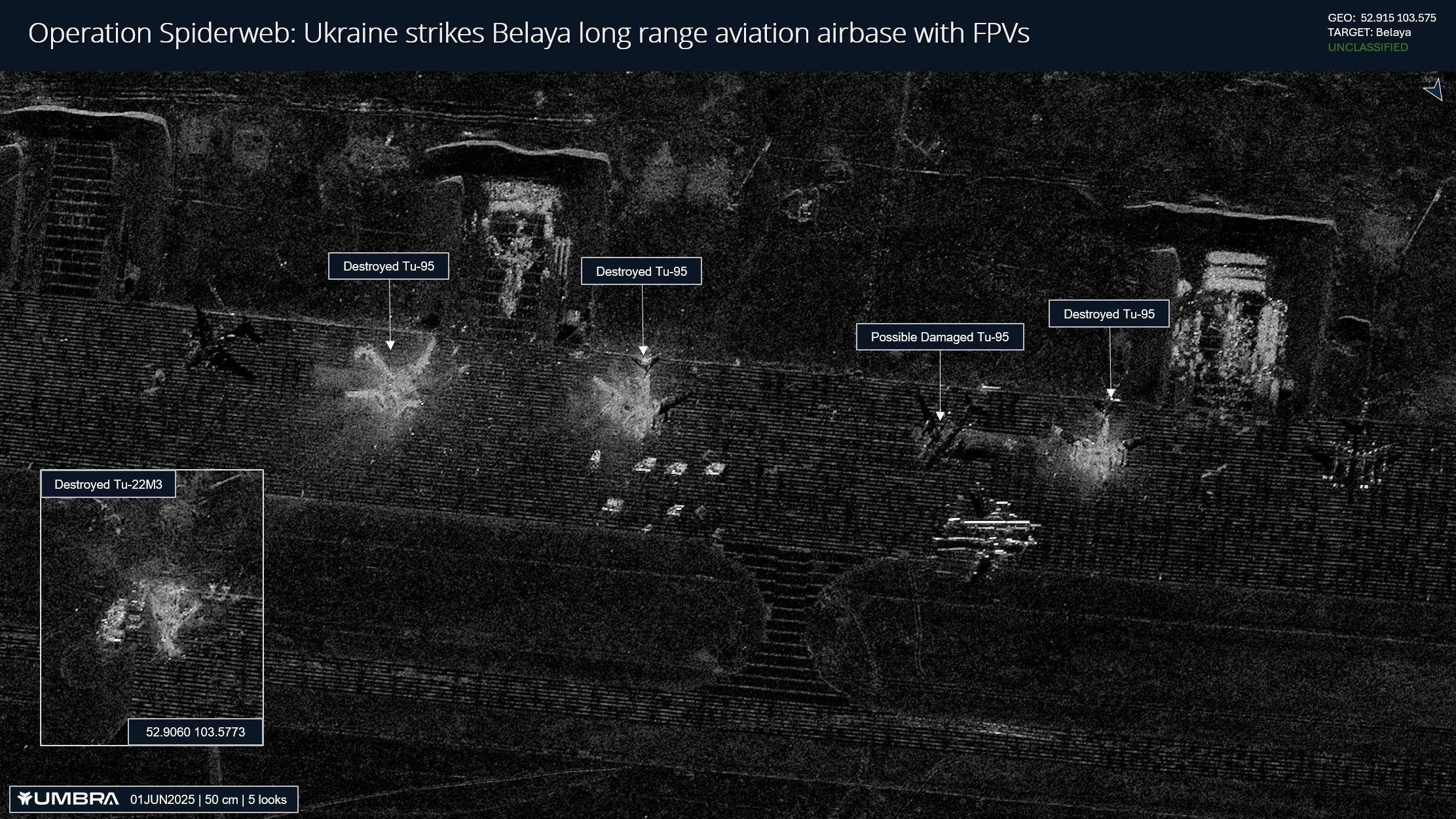
Ukrainian sources report having destroyed around 40 aircraft in total.
At the moment, however, we have concrete evidence confirming the destruction of about a dozen planes.
Still, it’s entirely plausible that the real number is higher.
The bombers, after all, weren’t housed inside hangars — they were parked out in the open, side by side, making them extremely vulnerable.
We’ll see, with upcoming updates, whether it becomes possible to determine the exact number of aircraft that were actually hit.
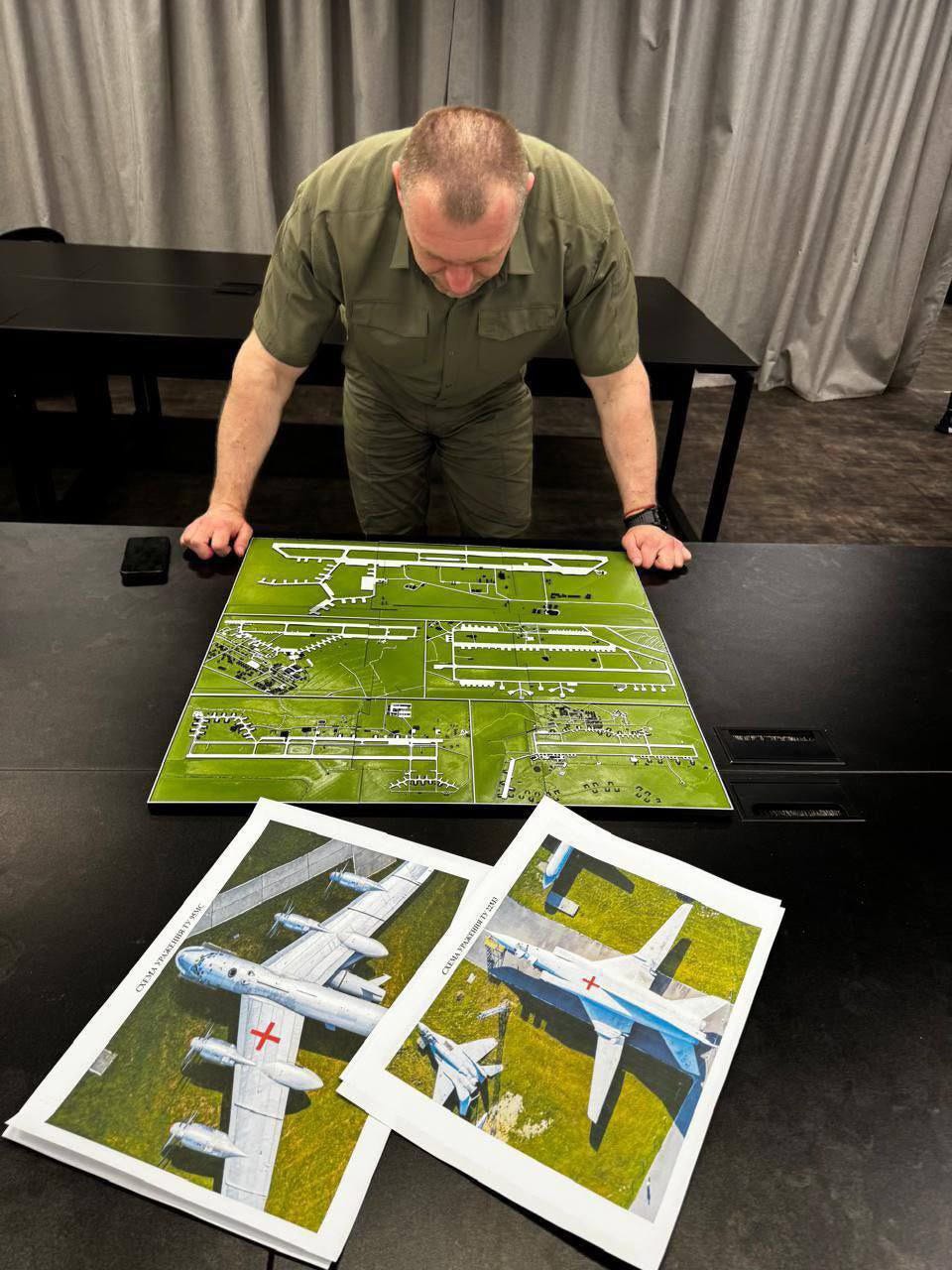
To wrap up the account of what happened — before I explain why this operation is, at the same time, extraordinary but pointless — let me show you this image (yes, a bit propagandistic): it shows Vasyl Malyuk, head of Ukraine’s security service, studying maps of the five airbases, alongside two images of the aircraft models involved.
What are the implications? (spoiler: none)
The first thing to say is that this operation is unprecedented in history.
The Ukrainians pulled off something that no one thought was possible.
Like it or not, that achievement deserves recognition.
For now, we can only speculate on how such an attack was even feasible.
One of the more credible theories is that the materials needed to assemble the drones and containers were brought into Russia via Kazakhstan — using the same kinds of trade triangulations the Russians rely on to evade Western sanctions.
This is an operation destined to end up in history books.
And it won’t be forgotten any time soon.
For Russia, this is a blow to its image: it looks vulnerable, exposed — almost powerless.
In the headline, I called this action “remarkable but pointless” — and that wasn’t clickbait.
It’s pointless in the context of the war.
The Russians are not, at least for now, running short on aircraft.
They’ll be able to keep deploying more without much difficulty.
40 aircraft were not destroyed — at least, there’s no evidence supporting that number yet.
And no, the damaged planes weren’t worth $7 billion: we’re talking about very old models, inherited from the Soviet Union.
Estimating their value is impossible, as they’re no longer in production.
With this article, I also want to make a call for caution: don’t blindly trust the propaganda.
Not Russian, not Ukrainian, and certainly not Western.
Always read critically, check your sources, and ask questions.
Many claim that an A-50 AWACS was also destroyed — but as of now, there’s no proof.
If it turns out to be true, that would actually be even more significant than the destruction of the bombers.
And just as I write these lines, news breaks of a third Ukrainian attack on the Kerch Bridge in Crimea.
All we know for now is that about 1,000 kg of explosives reportedly detonated underwater, near the bridge’s main support pillars.
This is fresh information and should be treated with the appropriate caution: nothing has been confirmed yet.
I’ll end with a personal reflection.
It almost feels like the Ukrainians aren’t just trying to blow up Russian depots… but Russian tempers.
The more time passes, the more Moscow seems to be losing control.
Crack by crack.
A fracture that no one can ignore anymore.
Three years ago, no one in the Kremlin would have bet on a war this long.
Three years ago, no one in the West believed Kyiv could hold out.
And yet, here we are.
In the fourth year of war.
With airbases in Siberia hit by drones launched from shipping containers.
With Russia burning through billions trying to cover up the fact that, yes, it’s stumbling.
And with every passing month, it stumbles a bit more.
The Ukrainians, on the other hand, don’t seem tired.
On the contrary.
They seem to be snarling.
They seem to be growing.
And maybe the question is no longer if they’ll win…
…but how much they’re willing to lose to make it happen.
In Italy, there’s a saying: “When two people quarrel, the third one wins.”
Guess who the third is.
Per aspera ad astra.