
The Arctic Gambit: Could a U.S.–Russia Deal Rewrite the Future of the Ukraine War?
Climate change, new sea routes, and a war of attrition Moscow can’t sustain may be pushing Washington to reconsider its red lines.

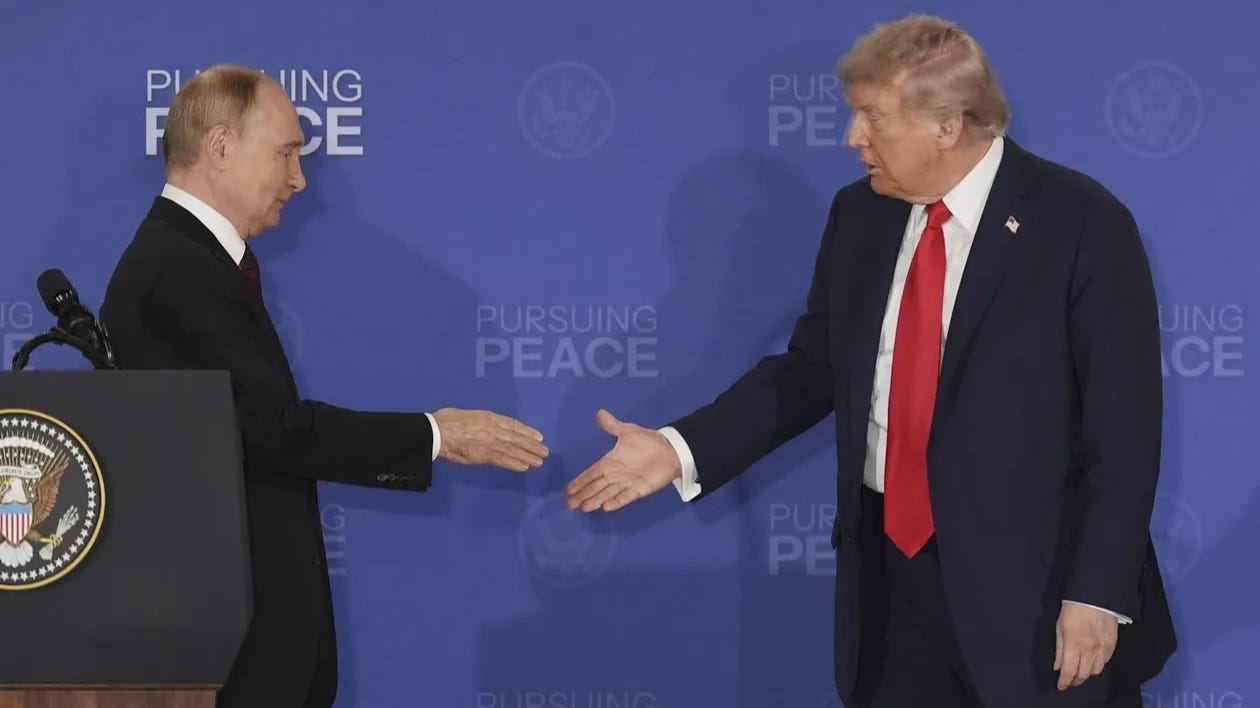
The world still remembers that handshake: Putin and Trump in Alaska, last August 15th.
A date engraved in memory not only because, in Italy, it coincides with Ferragosto — but because, for the first time after years of tension, the two leaders met to “talk about peace.”
A word everyone likes. It’s difficult for any American citizen to criticize a meeting presented as a gesture of de-escalation. But anyone familiar with U.S. politics knows that the campaign cycle never really ends: it remains a constant engine, and every public move is calculated on a geopolitical chessboard.
In this context, peace becomes also — and perhaps above all — a useful narrative, an ideal frame for winning support.
What did Trump really want from Putin?
Many interpreted that meeting as a simple image-building exercise:
a photo opportunity to fuel the rhetoric of the “peacemaker”;
a way to project an image of pragmatic leadership;
or, as others argue, a business opportunity, a conversation to explore new economic deals advantageous for the United States.
And yet, behind that handshake, there may be much more.
According to some interpretations, Trump may have opened the door to Russia in exchange for geopolitical concessions: an unspoken understanding in which the U.S. would scale back its involvement in Ukraine, allowing Putin to end the war in the Donbas while proclaiming a “Russian victory.”
Is Ukraine a sacrificial pawn?
In many of my previous articles, I’ve argued a clear thesis: the United States is using Ukraine to weaken Russia, as part of a broader strategy aimed at isolating China.
A logical theory, consistent with the American view of a bipolar world in which Beijing represents the true challenge of the 21st century.
However, the reflection remains open. For intellectual honesty — and to encourage critical thinking — I like to question even my own convictions.
And so I ask myself:
How far can Russia push before risking internal collapse?
What is Moscow’s real objective? Reaching Kramatorsk while bleeding, hoping not to fall apart first?
