No, One Million Russians Haven’t Died in the War in Ukraine
How Western Propaganda Plays on Your Ignorance

If you've been paying close attention to this conflict, you’ve probably come across the claim that one million Russians, including soldiers and fighters, have died in Ukraine over the past three years of war.
False.
It’s a deliberately crafted lie. But, as is often the case, even the boldest lies contain a grain of truth.
With this article, I want to dig deeper and set the record straight, showing precisely how Western media play on our ignorance, leading us to believe what best serves their interests.
I’m an Italian citizen — a conscious and integral part of the Western world.
And precisely because of that — and in the name of our core values, including freedom of speech and of the press — I cannot remain indifferent when information is distorted and our perception manipulated.
Our ideas shape our votes, and our votes determine the political direction of our country.
Being well-informed means being clear-headed, responsible citizens who can take part knowingly in the democratic process.
In my articles, I aim to bring the truth to light — especially where propaganda casts its darkest shadows.
Don’t be fooled by oversimplifications.
Don’t let others do the thinking for you.
Subscribe for free to support my work and make sure you don’t miss content like this — content meant to awaken critical thinking and civic awareness.
The Big Lie
Let’s start with the facts.
Let’s go back to June 12, 2025.
It’s been about three years and four months since the beginning of the full-scale war in Ukraine.
The Kyiv Independent — one of Ukraine’s leading news outlets — publishes a daily bulletin summarizing estimated Russian losses, as reported by the Ukrainian Ministry of Defense.
These bulletins include figures on troops, equipment, vehicles, and destroyed military assets.
On June 12, as on every day, the outlet published its update.
But this time, one detail caught many people’s attention:
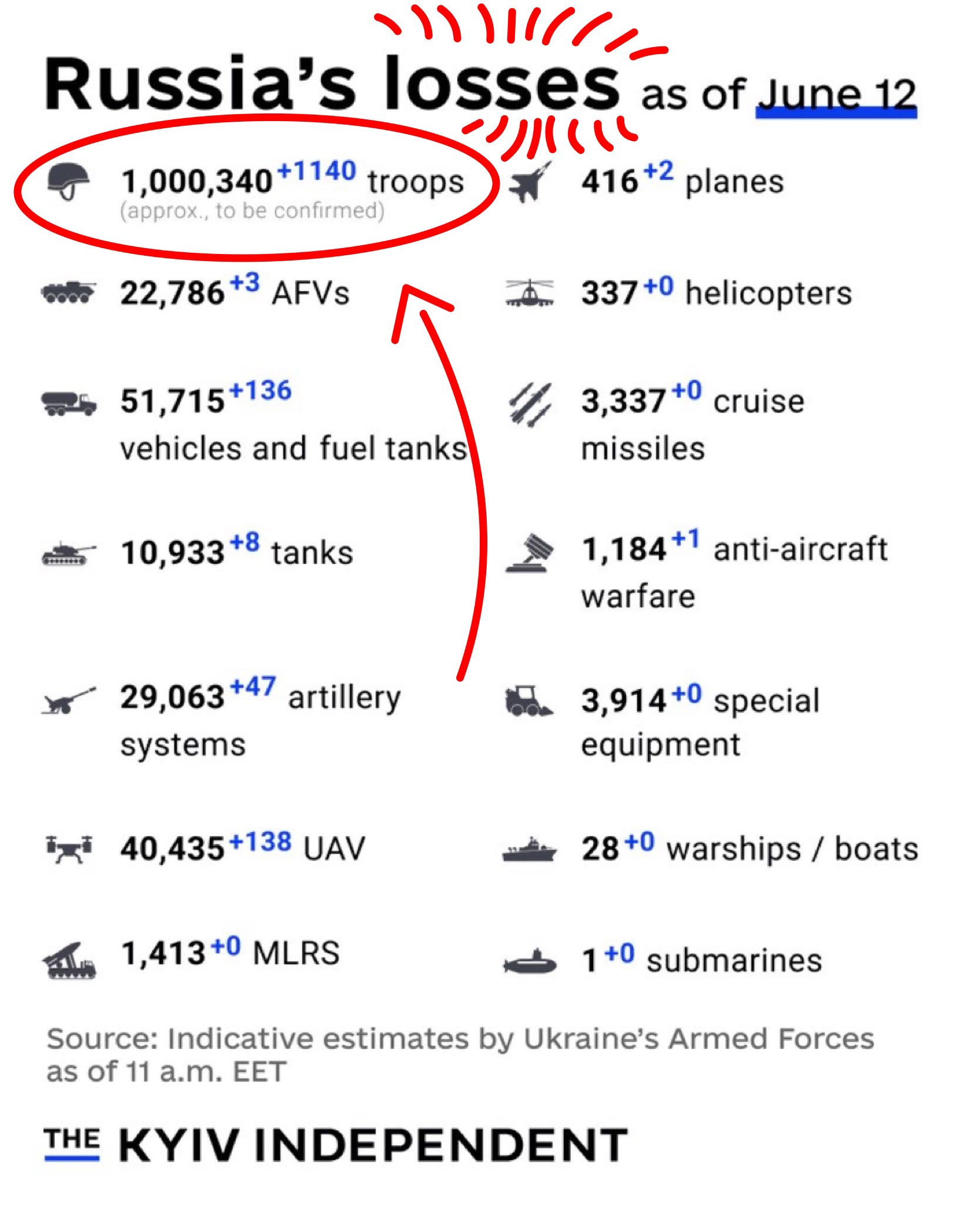
Russia’s losses:
1,000,340 troops
A figure that, on its own, is no more meaningful than 999,999 or 1,000,001.
But we all know: humans are drawn to round numbers, to symbolic milestones.
Seven digits. A round, striking, powerful number.
Still, let’s go back to the data.
The Kyiv Independent, citing official Ukrainian sources, reported that among Russia’s “losses” were over one million troops.
The news circulated widely, though not as much as it could have.
Overshadowed by the headlines of the Spider Web operation and the 12-day Middle Eastern war, many didn’t give this number the attention it deserved.
But now, pay close attention to the wording.
The word “losses” is vague, ambiguous — even misleading.
It evokes death, certainly. But it doesn’t define it.
It’s common — in both Italian and English — to say “I lost my father” or “I lost my grandmother” when referring to a loved one who passed away.
But in a military context, “losses” can also include wounded soldiers, missing personnel, prisoners of war, deserters, or even those rendered unfit for combat due to psychological reasons.
This is where the deception lies — the half-truth that undermines our critical thinking, erodes our trust in facts, and ultimately threatens the very health of our democracies.
So, the question remains:
Have one million Russians really died?
Debunking the Propaganda:
Let’s start with a simple truth: this entire narrative stems from a misunderstanding.
Whether it originated in good faith or with manipulative intent, I can't say for sure.
What is certain, though, is that this kind of story relies on one crucial element: the reader’s ignorance.
When people talk about 1,000,000 “losses”, what they’re really referring to are “casualties” — a term that does not mean “deaths”.
The word casualties refers to all individuals who are no longer fit for combat, regardless of the reason.
Let’s break it down.
Included within casualties are:
KIA – Killed in Action
Soldiers who were actually killed during the conflict.
WIA – Wounded in Action
Severely wounded. We’re talking about men who have lost a limb, their sight, hearing, or use of their arms.
These are individuals who will never be able to fight again.
(Those who suffer minor injuries but remain fit to serve in compatible roles are not counted among the WIA.)
Severely ill individuals
Those who, due to chronic conditions or illnesses developed during the war, can no longer take part in the war effort.
POW – Prisoners of War
Captured soldiers.
Missing in Action
Missing troops. They could be dead, captured, on the run, or deserters. No one really knows where they are.
Now, let’s go back to that initial claim:
Russia’s losses:
1,000,340 troops
Does that number sound different now?
Now that you know what “losses” actually means,
how do you feel?
If you were among those who believed it referred to a million deaths,
you might be feeling deceived — betrayed by information that seemed genuine.
If, on the other hand, you were already aware of the technical meaning of casualties,
you’re probably smiling bitterly, knowing just how devious information can become when it’s meant to shape perception.
In either case, I believe we can agree on one essential point:
Propaganda exists on our side too.
We’re not immune to it just because we live in a democratic and Western society.
On the contrary — precisely because we live in a more sophisticated media environment, our propaganda is more refined, more subtle, more dangerous.
In Russia, information is often suppressed, or replaced with official lies that no one dares to question.
In our world, manipulation relies on half-truths, linguistic tricks, and semantic ambiguity.
It lets you believe you know, while in truth it’s feeding you exactly what it wants you to believe.
I want to make this clear:
I cited The Kyiv Independent merely as an illustrative example,
but this critique applies to any newspaper, blog, commentator, or influencer who reported the number without clarifying the actual meaning of the term “losses” — or worse, by outright saying “deaths — one million deaths.”
This isn’t about taking sides.
It’s about truth.
I’m also fully aware that all Ukrainian sources — simply by being Ukrainian — are biased, propagandistic, and ambiguous.
And yet, this claim of a million “lost” soldiers has also been echoed by non-Ukrainian Western sources.
A friend of mine, while chatting in person, asked me what I thought about this massive death toll.
I had to explain to him what the truth really was...
He felt like a fool — naive and misled.
So Then, How Many Russians Have Really Died?
I know that’s what you’re wondering.
I’ve wondered the same.
After everything we’ve discussed, after exposing the ambiguity of the term “losses,” the desire to uncover the raw, unfiltered truth is only natural.
But this is where things get complicated.
The war in Ukraine is, in many respects, a war like no other.
Never before, in the history of modern conflicts, have we had access to such a vast amount of real-time information:
dynamic maps, OSINT updates, drone footage, amateur phone recordings, Telegram sources, commercial satellite imagery.
Yet paradoxically, this overflow of information doesn’t guarantee transparency.
In fact, it often creates the opposite effect: confusion, contradictions, disorientation.
Who’s telling the truth? Who has a reason to lie? Who actually has access to the real data?
To answer the question, “how many Russians have really died?”, we must start from one essential fact: no one can provide an exact number.
Not even the governments involved.
Not even the intelligence agencies.
Not even independent NGOs.
What we can do is analyze the most reliable estimates, compare the most credible sources, and build a realistic picture through data cross-referencing, triangulation, and independent comparisons.
There’s a second key point to consider: The issue of casualties is highly sensitive, which makes it a prime target for propaganda.
Governments, news outlets, influencers, analysts, and activists all use numbers as narrative weapons.
A statistic can become a cry of pain, a political accusation, or an ideological shield.
In this context, doing journalism means above all exercising discernment.
Not blindly believing the first figure we come across.
Not letting ourselves be led by political bias or emotional reactions.
But instead, stopping, breathing, and asking:
“Is this source credible?”
“Has it explained how the data was gathered?”
“Does it have an interest in inflating or downplaying the number?”
That’s why, when it comes to death tolls, no single source is enough.
We must consult multiple sources, analyze their language, detect inconsistencies — and only then begin to form an opinion.
An opinion that won’t be perfect, but will be informed, thoughtful, and critical.
Only in this way can we become truly informed citizens, in a world that so often offers us nothing more than the illusion of information.
Meduza:
On February 24, 2025, marking the third year of war, Meduza reported approximately 160,000 deaths.
Meduza is an independent media outlet founded by exiled Russian journalists and based in Riga, Latvia.
It was created to bypass Kremlin censorship and provide free, uncensored information to both Russian and international audiences.
Today, it is regarded as one of the main channels of Russian counter-information, and has been labeled a "foreign agent" and subsequently banned by Russian authorities.
Meduza and Mediazona can now reveal that an estimated 160,000–165,000 Russian soldiers, officers, contract troops, mobilized personnel, and other fighters have been killed since February 2022. This statistical estimate of excess male mortality over the course of the full-scale war is based on comparing and analyzing various records. Namely, confirmed casualty lists compiled by volunteers and inheritance case data from Russia’s National Probate Registry. However, this estimate does not include foreign nationalswho fought for Russia, such as residents of Luhansk, Donetsk, and other occupied Ukrainian regions. It also accounts only for fatalities, excluding wounded soldiers.
CSIS – Center for Strategic and International Studies
CSIS is one of the leading American think tanks focused on global policy analysis, headquartered in Washington, D.C.
Founded in 1962, it deals with security, economics, technology, and international affairs, providing high-quality research and reports to governments, media outlets, and institutions.
In the context of the war in Ukraine, CSIS produces estimates and strategic assessments based on OSINT data, military sources, and satellite imagery.
Russia will likely hit the 1 million casualty mark in the summer of 2025—a stunning and grisly milestone. Overall, a high of 250,000 Russian soldiers have died in Ukraine, with over 950,000 total Russian casualties, a sign of Putin’s blatant disregard for his soldiers.
ISW – Institute for the Study of War
ISW is an independent think tank based in the United States, specializing in military analysis and armed conflicts.
It is known for publishing daily updated maps, field reports, and tactical-strategic analyses, with a strong focus on modern warfare.
During the Russia–Ukraine conflict, ISW has established itself as one of the most widely consulted sources for understanding the operational developments of the war.
an unnamed NATO official stated that Russian forces are sustaining an average casualty rate of 1,140 personnel per day, of whom nearly 975 are killed in action (KIA) – a much higher number of killed than the standard one-to-three KIA-to-wounded-in-action (WIA) ratio.
Based on this information, my personal estimate is that the number of Russian deaths to date is around 200,000.
It’s important to remember that these are Western sources and therefore somewhat biased. Nonetheless, I believe the margin of error between reported data and the actual situation on the ground is not very large.
The figure of 200,000 seems reasonable and at least gives us an idea of the order of magnitude we are dealing with.
For completeness, again based on similar types of sources, Ukrainian KIA (Killed in Action) are estimated to be around 100,000. This number appears consistent if we consider that Ukrainians have mostly been on the defensive rather than offensive during this conflict.
Cultivate Doubt.
I’d like to conclude this article with a simple yet crucial reflection.
Whether it’s 100,000 or 300,000 Russian soldiers fallen, the fact remains that we are far from the “million” figure often repeated like a distorted mantra — a number used more to suggest than to inform.
A figure that doesn’t illuminate, but blinds.
And here lies the core issue.
In war, the first casualty is always the truth. Always.
This war is no exception.
We live immersed in a fog of narratives, in an endless stream of images, numbers, and proclamations.
But how many of these data points truly tell the reality?
And how many are constructed — scientifically, surgically — to manipulate our view, our memory, or our conscience?
That’s why I urge you to cultivate doubt.
Not to become cynical, but to become free.
Doubt when the news looks too perfect.
Doubt when a statistic confirms everything you already believed.
And most of all, doubt when they tell you “there’s nothing to understand.”
Behind every number and every word, there is a choice — and every choice has an intention.
For my part, I will keep searching for that restless truth that refuses to be boxed into press releases or ideological slogans.
I will keep writing, verifying, questioning.
Out of respect for those who read me.
Out of respect for those who die.
And out of respect for the values — freedom, responsibility, critical thinking — that should be the beating heart of the Western world.
Thank you for reading until the end.
I hope this article leaves you not only with one more piece of information but also with one more thought.
A living spark of awareness.
Because today, doubting isn’t just an act of intelligence.
It’s an act of freedom.
Per aspera ad astra.