
Is Trump Planning to Attack Venezuela? Why?
Everything You Need to Know: Drugs, Maduro, Russia, Geopolitics — and, Above All… Oil.

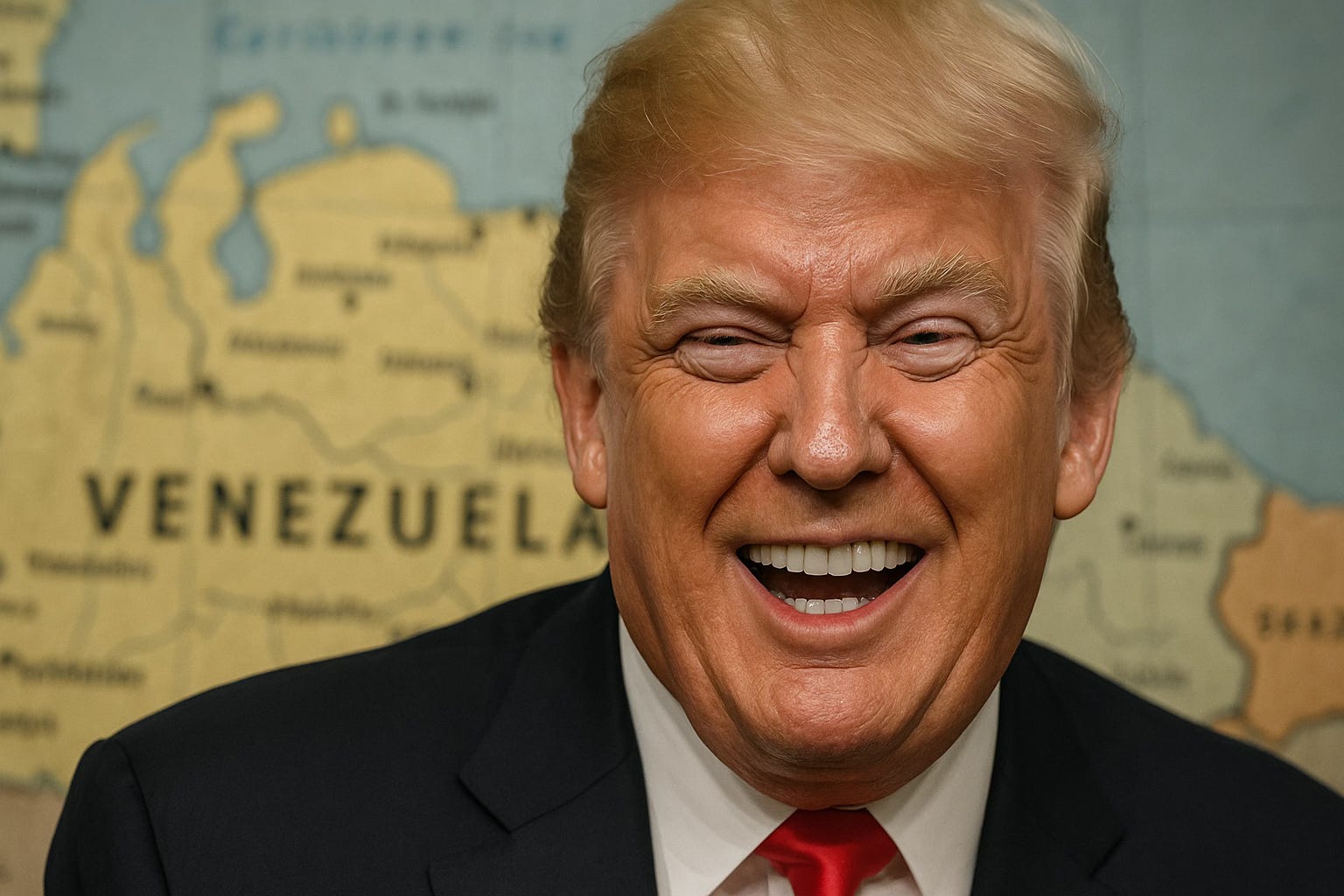
In recent weeks, a series of mysterious “incidents” has stirred the waters of the Caribbean Sea. Around a dozen vessels were struck and sunk, resulting in the deaths of some seventy people.
According to statements by then–U.S. President Donald Trump, those boats were carrying large shipments of drugs bound for American shores.
A quick and reassuring explanation in its simplicity — one that fits neatly within Washington’s familiar “war on drugs” narrative. And yet, something doesn’t quite add up.
Behind that official storyline, one can clearly see cracks, omissions, and coincidences too perfect to be accidental.
Why are these operations taking place now? Who were the men and women aboard those ships, really?
And above all: why do the United States suddenly seem so interested once again in Caracas?
These questions open up a much broader — and potentially unsettling — scenario.
What might appear to be a straightforward anti-narcotics operation is, in fact, a new chapter in a story that began more than twenty years ago: a story woven with economic sanctions, political prisoner exchanges, Nobel Peace Prizes, and the constant shadow of foreign powers hostile to Washington.
It’s a complex plot that, in many ways, echoes the story of Cuba during the Cold War, when a small South American nation became the stage for a global confrontation.
Today, Venezuela seems to be retracing that same path.
To be sure, the drug problem in the United States is both real and severe. But it would be naïve to think that everything revolves around a few shipments of cocaine.
As an old saying goes, “When the wise man points to the moon, the fool looks at the finger.”
And perhaps, once again, someone is pointing at the moon precisely to make us look elsewhere.
The real issue, in fact, may lie elsewhere — in the delicate geopolitical balances that tie Venezuela to three major global players: Russia, China, and Iran.
Three powers that, for different reasons, have invested resources and influence in a country strategically vital for controlling both energy routes and the broader Latin American region.
So what role do these three nations play in Venezuela’s ongoing crisis?
And if striking Caracas were, in reality, a way to strike indirectly at Moscow, Beijing, and Tehran?
In the following lines, we’ll look beyond the surface to understand why “drugs” may not be the true target of this escalation — but rather a convenient distraction, a decoy concealing a geopolitical contest of global proportions.
And how Nicolás Maduro, caught between internal pressures and external enemies, risks becoming the next pawn sacrificed on the chessboard of a new, silent Cold War 2.0.
Pt. 1 The Facts: 11 Vessels Hit and a Divided Nation
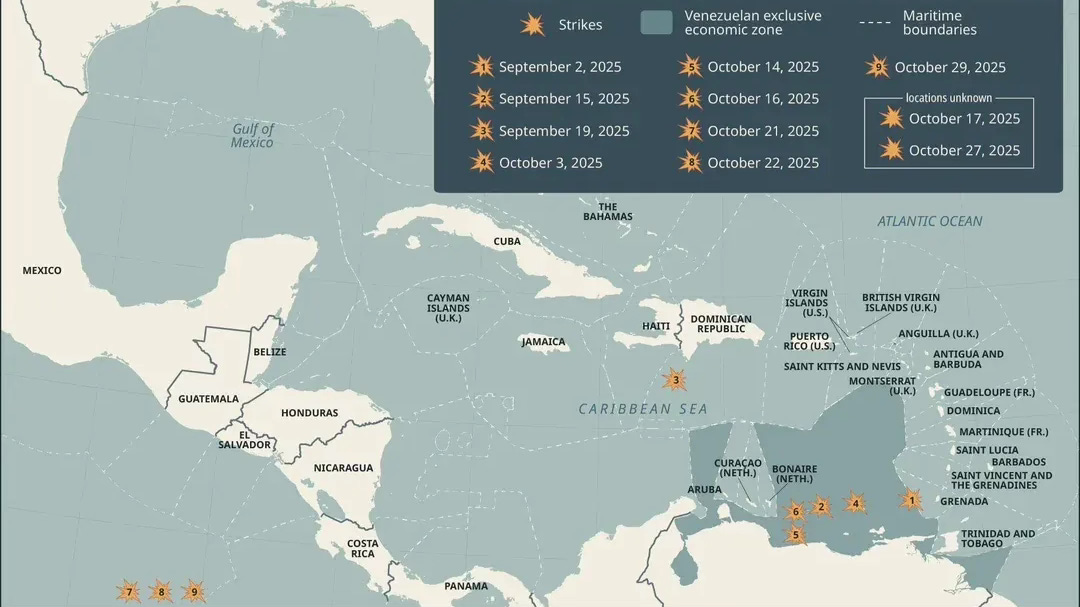
Starting on September 2 of this year, a series of maritime attacks reignited tensions in the Caribbean Sea.
Around twelve boats were struck and sunk, in what has been officially described as part of an ongoing anti-narcotics operation.
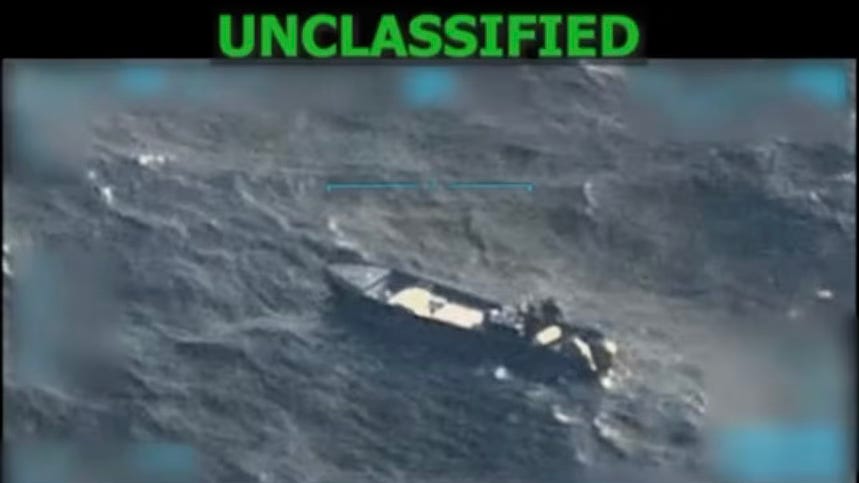
On social media — particularly on X — videos have circulated showing the explosions, the chases, and the devastating aftermath of these assaults.
The news has quickly split public opinion in the United States.
Not only among ordinary citizens, but also across mainstream media outlets, opinion leaders, commentators, and podcasters, the debate has focused on the legitimacy of President Trump’s actions.
Editorials, talk shows, blog posts, and podcasts have fueled an intense discussion: to what extent can such an intervention be considered lawful?
And more importantly: where is the concrete evidence that those small vessels were in fact carrying drugs?
Many observers have questioned whether it would have been more appropriate to conduct police-style operations rather than resort to overtly military means and methods, which have resulted in casualties and international backlash.
The legal issue, however, appears to be just the surface of a deeper debate — one that is political and strategic, where every word carries the weight of a bullet.
Maduro Calls for Peace, Trump Doubles Down
Meanwhile, the public confrontation between Donald Trump and Nicolás Maduro has grown increasingly fierce.
Both leaders have exchanged harsh accusations — yet with one interesting detail: neither of them explicitly mentions drugs.
While the media debate revolves around “coke” and “legality,” Trump and Maduro frame their messaging around other themes: security, peace, sovereignty, and self-defense.
It’s a deliberate choice of language — one that reveals far more than it seems.
Trump, for his part, maintains an aggressive stance, invoking the need to “protect freedom” and “restore order across the continent.”
Maduro, aware of the looming risk and the forces aligning against him, responds in a more measured tone, calling for “moderation,” “dialogue,” and “peace.”
Two opposing messages that nevertheless share a common goal: to shape domestic and international public opinion amid a phase of mounting tension.
Venezuela and Iran: Bound by the Same Fate
As Trump deploys some of the Pentagon’s most advanced naval and air units near the Caribbean Sea, Maduro appeals to his Russian and Chinese allies in an effort to reinforce an alliance strong enough to deter direct intervention.
A scene that feels as though it’s been lifted from a prewritten script.
Sound familiar?
It recalls other theaters of conflict — notably the confrontation between Israel and Iran, when the United States intervened with B-2 Spirit bombers.
Back then, Tehran had also hoped for Russian assistance, which never came — and, according to many analysts, history is likely to repeat itself today in Venezuela.
For now, the Kremlin watches, and Caracas waits — abandoned.
But as we’ll see later on, this apparent calm may well be only the prelude to a far more dangerous escalation.
Drugs as a Communication Pretext
Now that we’ve outlined the key events, we can take a broader view.
It has become increasingly clear that the boats that were struck serve more as a narrative pretext than as a genuine threat to U.S. security.
As official data confirm, the majority of drugs entering the United States do not come by sea, but rather through the land border with Mexico — a steady, nearly uncontainable flow.
And Donald Trump knows this perfectly well.
We are not talking about an inexperienced politician, but rather a skilled communicator, capable of building public support even around the most controversial decisions.
As I have often emphasized in my articles, to be president in a democratic system means, above all, to know how to communicate.
Trump and Public Support: Politics as Narrative
Every democratically elected president understands that their political survival depends on the ability to connect with their electoral base.
Trump is no exception.
He knows the psychological and cultural profile of his voters well: Americans who believe in isolationism, in national primacy, and in the necessity of withdrawing from the global stage.
However — and here lies the paradox of every hegemonic power — the United States cannot truly afford to isolate itself.
A dominant empire thrives on influence, on external projection, and on control over the planet’s strategic regions.
To give all that up would mean relinquishing its status and yielding ground to its rivals: Russia, China, and Iran.
Trump knows this.
And his task is not only to make difficult decisions, but to know how to tell the story in the right way.
The success of foreign policy, after all, depends not only on what is done, but on how it is perceived.
The “War on Drugs” as a Political Message
If the United States truly intends to strike at the government in Caracas — and, as we’ll see, there are very concrete geopolitical reasons to do so — the first step is to craft an acceptable narrative for the American public.
And what narrative could be more effective than the fight against drug trafficking?
It’s a cause that unites the electorate, transcends partisan divides, and provides a moral justification for any military or economic action.
From this perspective, Venezuela is the perfect target: a state marked by narcotics trafficking, ruled by an authoritarian government and a president long accused of corruption, repression, and collusion with the cartels.
The analogy with other regimes is inevitable.
Bashar al-Assad’s Syria, repeatedly labeled a “narco-state,” offers a useful precedent for understanding the American logic:
first comes the construction of an ethical justification — the fight against evil, against drugs, against tyranny — and only then comes the intervention.
In the end, whether the real motives lie elsewhere — economic, geopolitical, or strategic — becomes almost irrelevant.
What matters is the public narrative, the way choices are explained, packaged, and accepted.
Trump, as a skilled communicator, knows this all too well.
Pt. 2 Is a U.S. Intervention Really Possible?
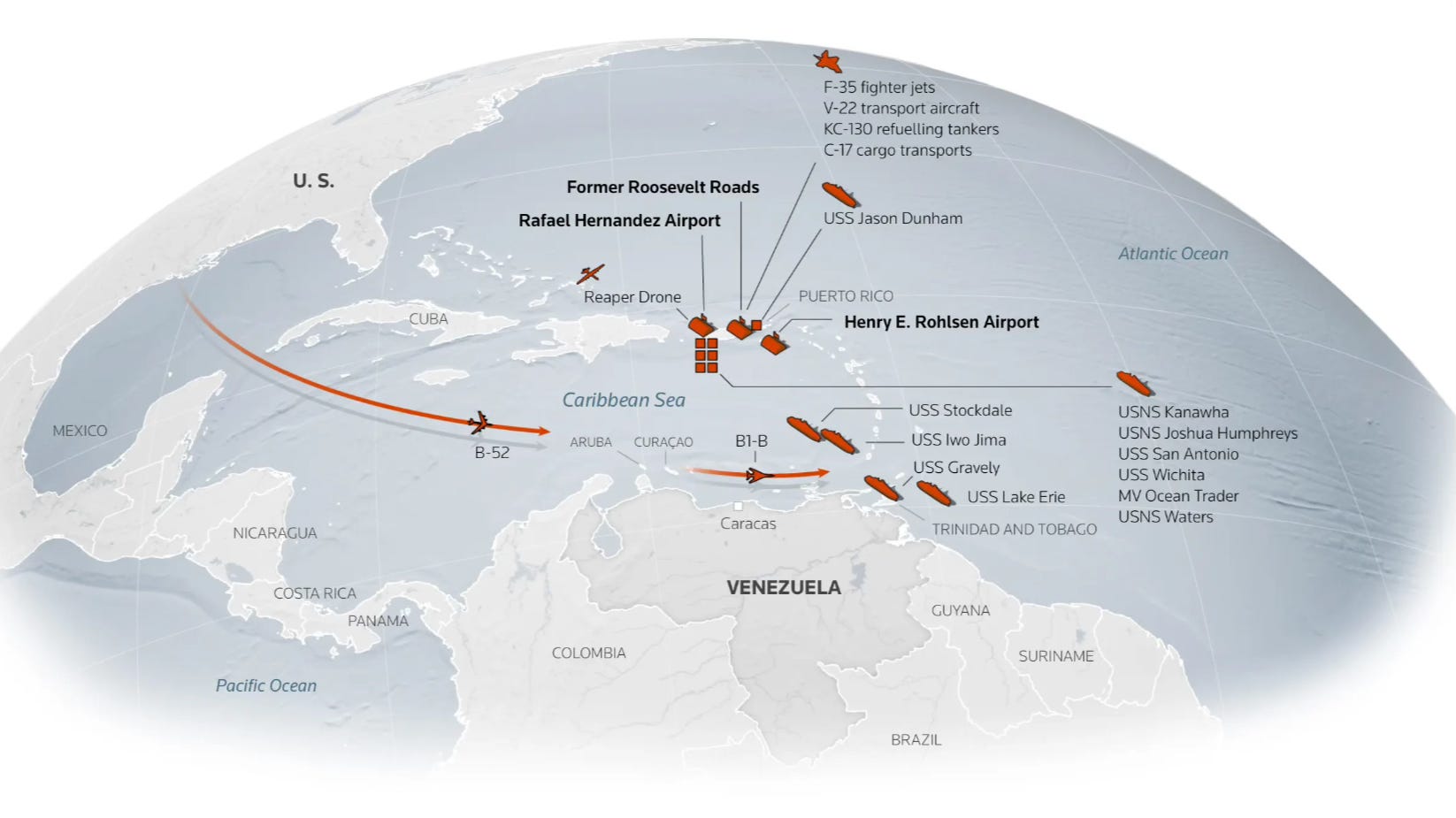
So far, we’ve seen how anti-drug rhetoric serves to pave the way for a possible escalation.
But how realistic is the idea of a U.S. intervention in Venezuela?
And, more importantly, what kind of intervention are we talking about — military, economic, hybrid, or diplomatic?
In the following lines, we’ll examine the likelihood, the methods, and the strategic advantages the United States might gain from taking direct or indirect action against Nicolás Maduro’s government.
From “Earthly Paradise” to Systemic Crisis
Not too many decades ago, Venezuela was a symbol of prosperity.
It was seen as a wealthy, fertile land full of opportunity.
Many Italians, along with other Europeans, left their homeland to settle there, drawn by what seemed like a “tropical American dream.”
Today, that dream has shattered.
The country is ruled by an authoritarian socialist regime, accused of exploiting its population and suppressing any form of dissent.
The economic crisis runs deep, poverty is widespread, and internationally, the nation stands more isolated than ever.
Venezuela has become, in every sense, a country in open opposition to the West — and particularly to the United States.
A country sustained by the backing of other revisionist powers: Russia, Iran, and China.
The Axis of “Enemies of the Enemy”
As I often point out, these countries do not truly like one another.
Their alliances are not born of cultural or ideological affinity, but of simple geopolitical calculation:
“The enemy of my enemy is my friend.”
That’s why, despite their differences, they support each other.
Because they share the same goal: to diminish U.S. influence and weaken the Western bloc.
Relations between Venezuela and Iran are especially strong in the energy and oil sectors.
Both nations endure severe economic sanctions imposed by the United States and the European Union, and for that reason they have developed parallel channels to sustain one another.
They exchange technology, expertise, and even refined products, circumventing the embargoes enforced by Western powers.
In this way, the victims of sanctions close ranks, seeking to survive within a global economy that largely excludes them.
Moscow and Caracas: An Alliance 25 Years in the Making
Ties with Russia run even deeper.
Over the past twenty-five years, their cooperation has expanded across numerous sectors, far beyond energy.
Since the early 2000s, Caracas has purchased weapons and military systems from Moscow, while Russia, in turn, has seized the opportunity to reassert its presence in Latin America — the United States’ own backyard, as it was called during the Cold War.
The strategy is clear: plant a foothold close to the enemy.
It’s a tactic strikingly reminiscent of the Cuban Missile Crisis of the 1960s, when the USSR deployed missiles just a few miles from Florida to counterbalance American presence in Europe.
Today, relations between Russia and Venezuela remain as strong as ever.
Their cooperation includes the supply of drones — a crucial technology in any modern conflict, as the war in Ukraine has shown.
And, as with Iran, the energy sector plays a central role: Moscow provides technical support and consulting, while Caracas brings to the table its vast oil reserves.
Beijing: The Silent Power
Though maintaining a more cautious military posture, it moves decisively on the economic front.
Taking advantage of Venezuela’s fragility, Beijing has extended billions of dollars in loans in exchange for oil and long-term concessions.
It has signed twenty-year agreements for joint crude production and for the rehabilitation of derelict facilities.
This is not altruism — it’s opportunism.
Gaining access to the South American energy market means expanding its influence in a region historically dominated by the United States.
Venezuela as a “Rogue State” and the Domino of Alliances
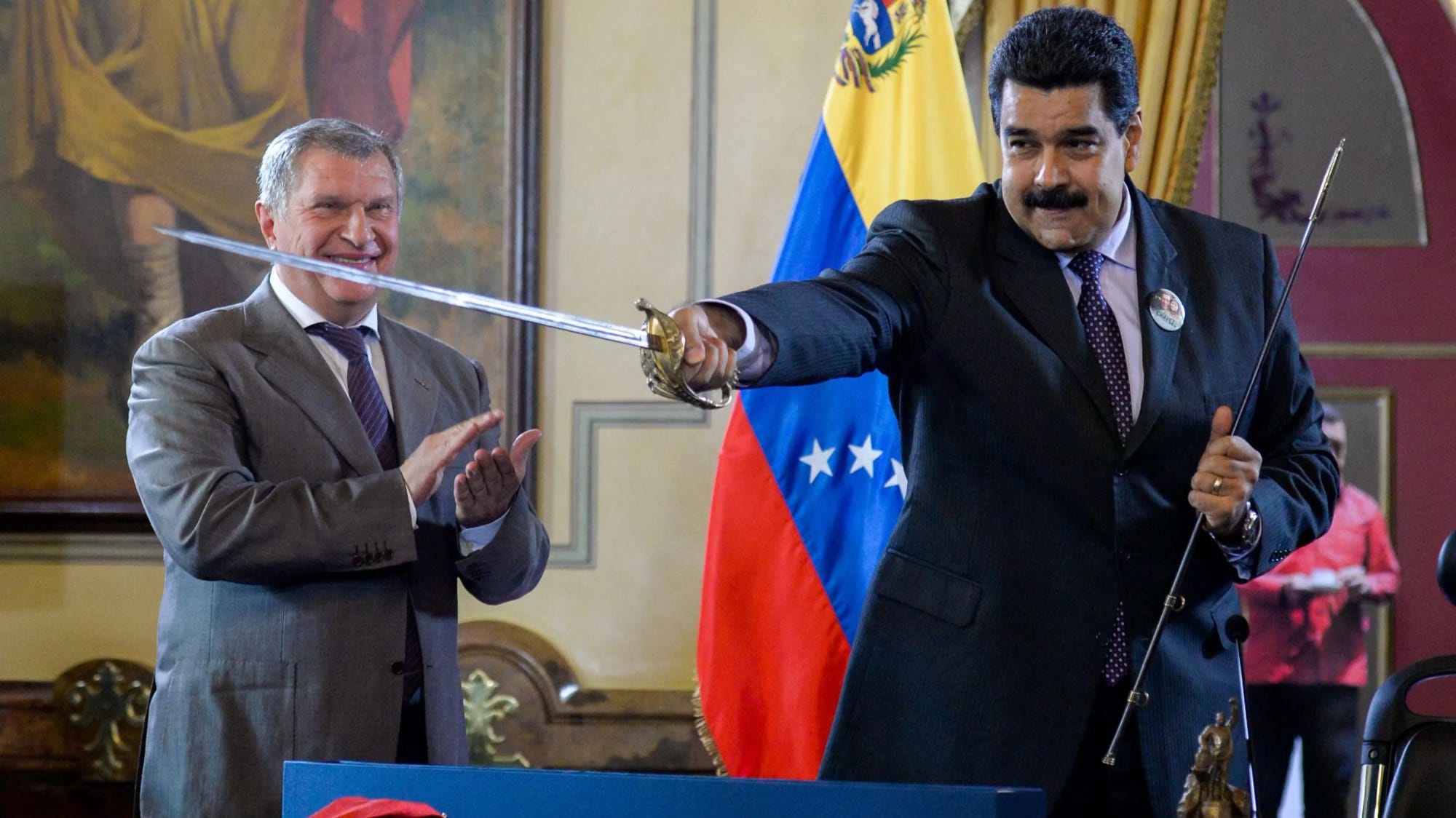
The result is clear: Venezuela perfectly embodies the concept of a rogue state.
It is hostile to Washington, collaborates with other rogue countries, and systematically circumvents sanctions.
Caracas’s alliances with Moscow, Tehran and Beijing serve to keep one another afloat.
But Western policies in recent years aim precisely at the opposite: to topple this house of cards.
Weakening one link means shaking the whole structure.
And in that sense, pressure on Venezuela is a blow not only to Maduro, but also to his international partners.
We have already seen some effects of this strategy:
Russia bogged down in a conflict now entering its fifth year.
Iran losing proxies and suffering targeted strikes against its air defenses.
A European Union once again talking about rearmament.
And Israel, increasingly central in the Middle East.
The Energy Factor: Oil as an Economic Weapon
Putin’s Russia continues to finance its war machine through exports of oil and refined products.
For this reason, U.S. and European sanctions aim to reduce Russia’s energy revenues, striking at its Achilles’ heel.
Two main levers are in play:
Punish those who buy Russian crude, via targeted sanctions.
Artificially drive down the price of oil, cutting Moscow’s profits.
This is precisely where Venezuela comes into play.
With its immense oil reserves — the largest on the planet, even surpassing Saudi Arabia — Caracas could become the perfect tool to flood the global market.
When supply rises, price falls.
And if the objective is to collapse crude prices to harm Russia, opening Venezuela’s taps would be a logical — and devastating — move. Pursuing this goal, however, would take years. It can’t be achieved in a few months: Venezuelan facilities are dilapidated and need time to be restored.
One Blow to Maduro, One to Moscow
Toppling Nicolás Maduro would not simply end an isolated regime.
It would mean severing the economic and military support network that binds Venezuela to its partners — the very partners most dangerous to the West.
At the same time, it would weaken Russia by depriving it of one of its principal revenue streams: oil.
In this sense, action against Maduro is not only a political operation, but an economic and strategic maneuver of global proportions.
A move that, if carried out, would reshape the planet’s energy balances.
Pt. 3 What Will Happen Next?
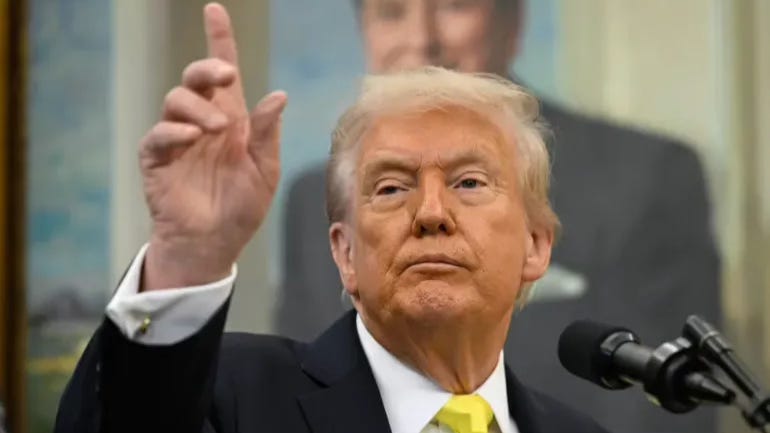
After reconstructing the facts surrounding the attacks on the boats, analyzing Donald Trump’s political communication, and outlining the strategic ties between Venezuela, Russia, Iran, and China, it’s time to confront the central question:
How credible is a U.S. intervention in Venezuela, and in what form might it take place?
The Least Likely Scenarios: Open War and Ground Invasion
Let’s begin with what is almost impossible.
I do not believe that the United States intends, in the short term, to launch a full-scale military invasion of Venezuela — anything resembling Russia’s campaign in Ukraine.
Such an operation would require a massive logistical mobilization, congressional approval, and an international consensus that Washington currently lacks.
Similarly, a large-scale missile campaign against the Nicolás Maduro regime is highly unlikely.
Some targeted strikes, perhaps even the elimination of key regime loyalists to send a message, are possible — but nothing comparable to a conventional war.
Attacking a sovereign state is never a simple or swift decision.
When Trump ordered the strike on Iran, his first words were: “The war is over.”
A way to contain domestic opposition, reassure voters, and project strength without crossing the threshold into open warfare.
And let’s not forget: the President of the United States cannot, on his own, launch a large-scale conflict.
The U.S. Constitution assigns that power to Congress, effectively limiting the possibility of unilateral action.
Economic, Military and Political Pressure: the Most Realistic Scenario
A far more plausible option is one in which the U.S. increases indirect military, economic and diplomatic pressure.
This is a tried-and-true model: hybrid warfare combined with economic soft power.
In practice, the regime is squeezed from within — by funding the opposition, imposing targeted sanctions, and isolating Caracas on the international stage.
A clear sign of this strategy is the growing attention toward the Venezuelan opposition.
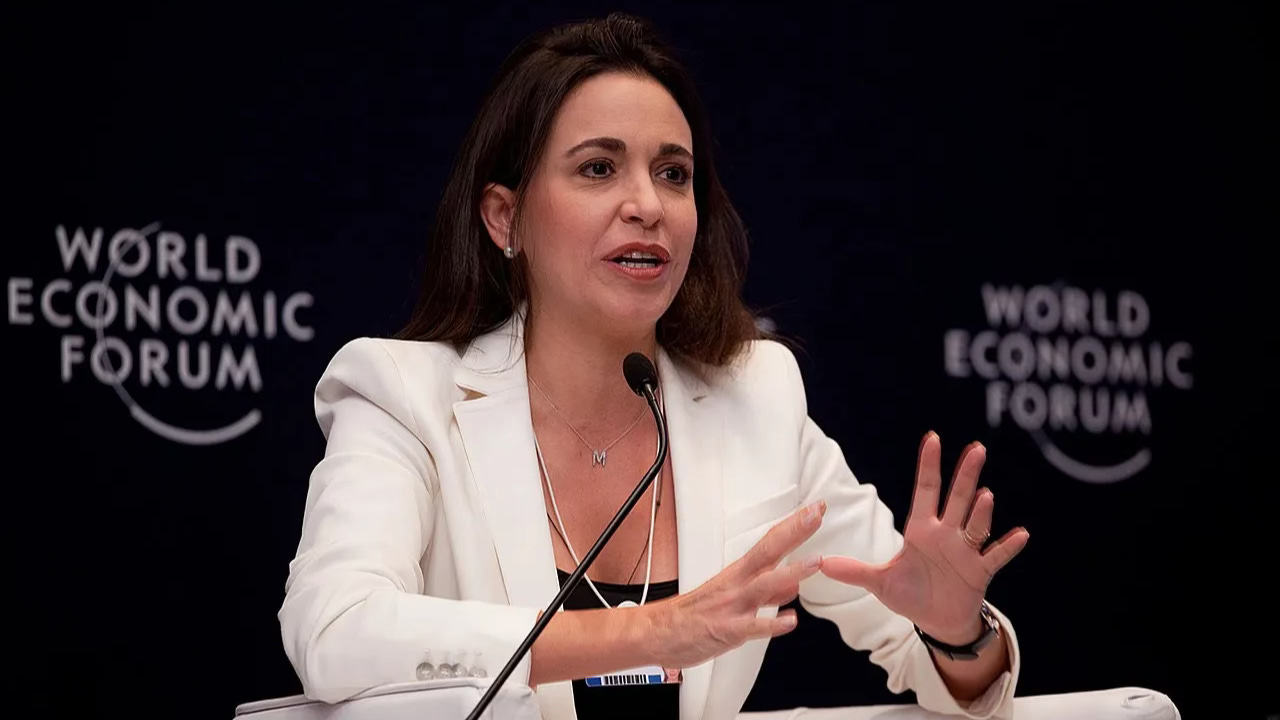
It is no coincidence that the 2025 Nobel Peace Prize was awarded to María Corina Machado, the longtime anti-Maduro leader.
Her profile is ideal to become the West-backed democratic face: a credible, media-savvy figure capable of representing a “free,” pro-Western Venezuela.
In the coming months, it is reasonable to expect a flow of economic, political and logistical aid to anti-Maduro forces.
Washington could step up targeted economic sanctions, freeze assets, and promote a new international diplomatic front to delegitimize Maduro.
Why a Direct Military Intervention Is Unlikely
The comparison with other recent conflicts is unavoidable.
Israel, for example, subjected Iran to weeks of bombardment without toppling the regime.
The “12-day war” shows that airpower alone is not enough to destroy an entrenched power.
The war in Ukraine also offers a clear lesson: a ground invasion, even if massive, does not guarantee political victory.
When a country fields a motivated military and benefits from external support (as Maduro does from Moscow and Tehran), regime change requires far more than missiles and armored divisions.
That is why the most plausible U.S. strategy is not bombs, but targeted funding, propaganda, and political influence.
Modern wars are won with information and economic leverage, not only with weapons.
Lessons from Syria and Libya: the Model of Funded Insurrection
The cases of Assad’s Syria and Gaddafi’s Libya remain instructive.
In both instances, the fall or weakening of the regime resulted less from bombardment than from support to internal opposition forces.
In Syria, Turkey and other Western countries financed HTS, forcing Assad to take refuge in Russia, fleeing like a coward.
In Libya, the disintegration of power came with NATO intervention and a popular uprising backed by foreign funds and intelligence.
Gaddafi, in the end, was killed by his own people.
The message is clear:
“You don’t need a foreign army to overthrow a dictator. You need a people who are ready, well organized and… a little outside help.”
The Venezuelan People as the Key to Change
In Venezuela, the decisive variable remains the Venezuelans themselves.
A regime collapses only when the bond of fear that sustains it breaks—when corrupt military elites realize they have more to gain by siding with the enemy than by defending their dictator.
As you may recall, during the first hours of the conflict in Ukraine, Putin urged Ukrainian generals to betray Zelensky, whom he described as a drug addict.
The same thing happened in Syria: when the rebels advanced south toward the capital, more and more people who had once been loyal to the government turned traitor. This led to Assad’s flight and a rapid takeover of power by the rebels.
During the Roman Empire, the weakest point of every emperor was his own bodyguards, who on more than one occasion killed the emperor, betraying him.
History repeats itself over and over again.
And breaking that bond requires two elements: an unmanageable economic crisis and steady, discreet external support.
An American “helping hand” — in the form of funds, intelligence, and diplomatic cover — could provide the fuel needed for the internal opposition to turn discontent into political action.
It’s a slow but effective strategy: we’ve already seen it work in Eastern Europe, the Middle East, and the Balkans.
The Strategic Interests of the West
At the core of everything lies a simple principle: economics drives geopolitics.
The Western world needs cheap oil to sustain its economies and reduce energy-driven inflation — especially countries like Germany, but also Trump himself, who has promised his voters to lower fuel prices.
At the same time, weakening Russia means cutting off its oil revenues.
A “liberated” Venezuela, reopened to Western markets, would have a dual effect:
lowering global oil prices,
and directly hitting Moscow in its main source of funding.
That’s why Maduro’s fall would represent a geopolitical, economic, and energy victory for the United States and for the entire NATO bloc.
Every step forward in Caracas would translate into a step back for Putin and his allies.
America’s “Special Military Operation”
Venezuela is not merely a local crisis: it has become the new battleground of global geopolitics.
Behind the rhetoric of the “war on drugs” lies a much larger game, where Trump, once again, wields communication as a strategic weapon to prepare public opinion for unpopular yet calculated decisions.
Caracas has become the perfect symbol of a clash between opposing blocs: on one side, the United States and its Western allies; on the other, Russia, Chi
na, and Iran, bound by a fragile but effective pact of resistance.
The fall of Maduro would not just mark the end of a regime, but the beginning of a new geopolitical and energy balance—one capable of reducing dependence on Russian oil and giving new oxygen to Western economies.
No missiles or invasions will be needed: this new war is fought through sanctions, finance, information, and persuasion.
And if the wind of change truly begins to blow over Caracas, it will be because the United States continues to win without firing a shot — unlike in Ukraine, Syria, or Gaza — through the silent power of strategy, diplomacy, and economics.
Today, Venezuela is merely the opening chapter of a Cold War 2.0 — fought with different means, but driven by the same ambition: to decide who will control the future of the world.
Per aspera ad astra.
Thank you for reading.
If you enjoyed my view of the world, I invite you to learn more about my values, my ideals, and how I can help you. ⬇️
Who I Am, What I Write About, And what you can learn

Hello, and thank you for stopping by my profile.