
And just when we least expected it, Ukraine’s SBU drops a five-minute video.
No noise, no fanfare—just footage quietly rolling by, showing all—or maybe only some—of the strikes carried out on June 1st against Russian military airfields.
Over the past few days, I was among those reporting around ten aircraft destroyed.
A cautious estimate, based on what we could actually verify.
The Ukrainians, on the other hand, were claiming forty aircraft hit.
But without proof, it was hard to believe.
Propaganda?
Now, with this video, the picture shifts.
We now know that at least twenty aircraft were attacked.
Is that the final count? Or are there more clips yet to be released?
But perhaps the most intriguing part isn’t that ten confirmed hits are now joined by ten more.
The key detail lies elsewhere.
A subtle moment, easy to miss—but potentially huge in its implications: the video shows two A-50s being targeted.
Two A-50s: strategic aircraft, the electronic eyes in the sky, a rare and hard-to-replace asset for the Russian Air Force.
Were they actually destroyed?
And if so, were they in service—or were they just husks? Aircraft the Russians weren’t even using anymore?
Is this truly a major blow for Moscow?
A lot of questions remain unanswered.
And there are some key points to reflect on.
A special thank you goes to you, the reader.
If you enjoy my take on things, let me know in the comments.
Thanks for opening this article.
Before diving into the details, let’s watch the video.
What you’re about to see isn’t just a flashy edit—it’s a high-stakes, five-minute sequence of 22 separate strikes on aircraft.
Each clip is a fragment of war, recorded through the very eyes of kamikaze drones, flying straight toward Russian bombers right up to the fatal moment of impact.
But don’t expect classic action footage.
The explosion ends the broadcast abruptly, leaving us with a haunting question:
Did the hit land?
To find out, the real-time video isn’t enough.
You have to wait—sometimes for hours, sometimes days—until high-resolution satellite images finally reveal the true outcome of the strike.
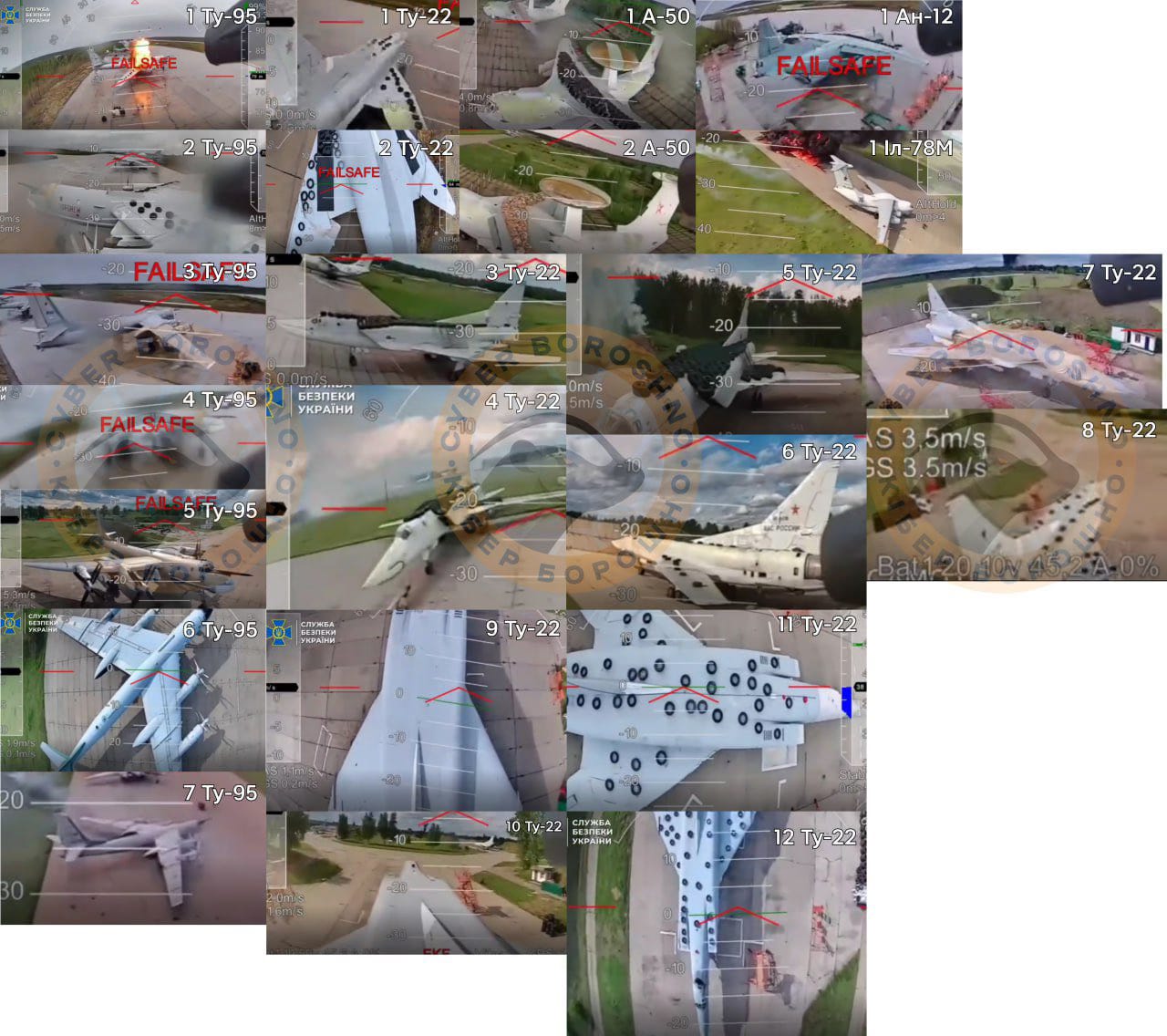
Here they are. Twenty-two steel silhouettes gone up in smoke.
In the image above, you can count them one by one:
7 Tu-95
12 Tu-22M3
2 A-50
1 An-12
1 Il-78M
A massive haul—at least on paper.
But how much is this strike really worth?
That’s where things get interesting.
In my last article, I analyzed the first 10 confirmed aircraft.
Today, I want to go further and tackle a question no one seems to have the guts to ask:
What if these $7 billion worth of "damaged assets" are just an illusion?
I keep hearing it repeated everywhere as if it were gospel: “$7 billion in damage to the Russian Air Force.”
And yet no one bothers to ask what kind of aircraft were hit.
Were they operational? Flight-ready?
Or were they just parked wrecks, abandoned for months, useful only for scavenging spare parts?
Because yes, here’s a detail many overlook—or pretend not to see:
Russia keeps dozens of bombers sitting in its military airfields like museum pieces, often grounded, sometimes partially dismantled, just waiting to be cannibalized to breathe new life into other aircraft.
So the question is legitimate:
How many of these 22 were actually ready to take off?
How many were actively bombing Ukraine?
The truth is, we don’t know. Not yet.
But that doesn’t mean the strike was pointless—far from it.
Even if they were nothing but scrap metal, the embarrassment is massive.
Russia got hit at home, with surgical precision, by drones that made it exactly where no one was ever supposed to get.
It’s a slap in the face.
A humiliation.
A deep crack in the narrative of invincibility the Kremlin so desperately tries to maintain.
But... there’s a but.
If those bombers were in fact active, if they were exactly the ones dropping death over Ukraine… then we’re looking at a military earthquake.
A sharp blow to the heart of Russia’s strategy.
A message as clear as it gets:
No aircraft is safe anymore. Not even your favorite one, Vladimir.
And now let’s move on to another target: the A-50s.
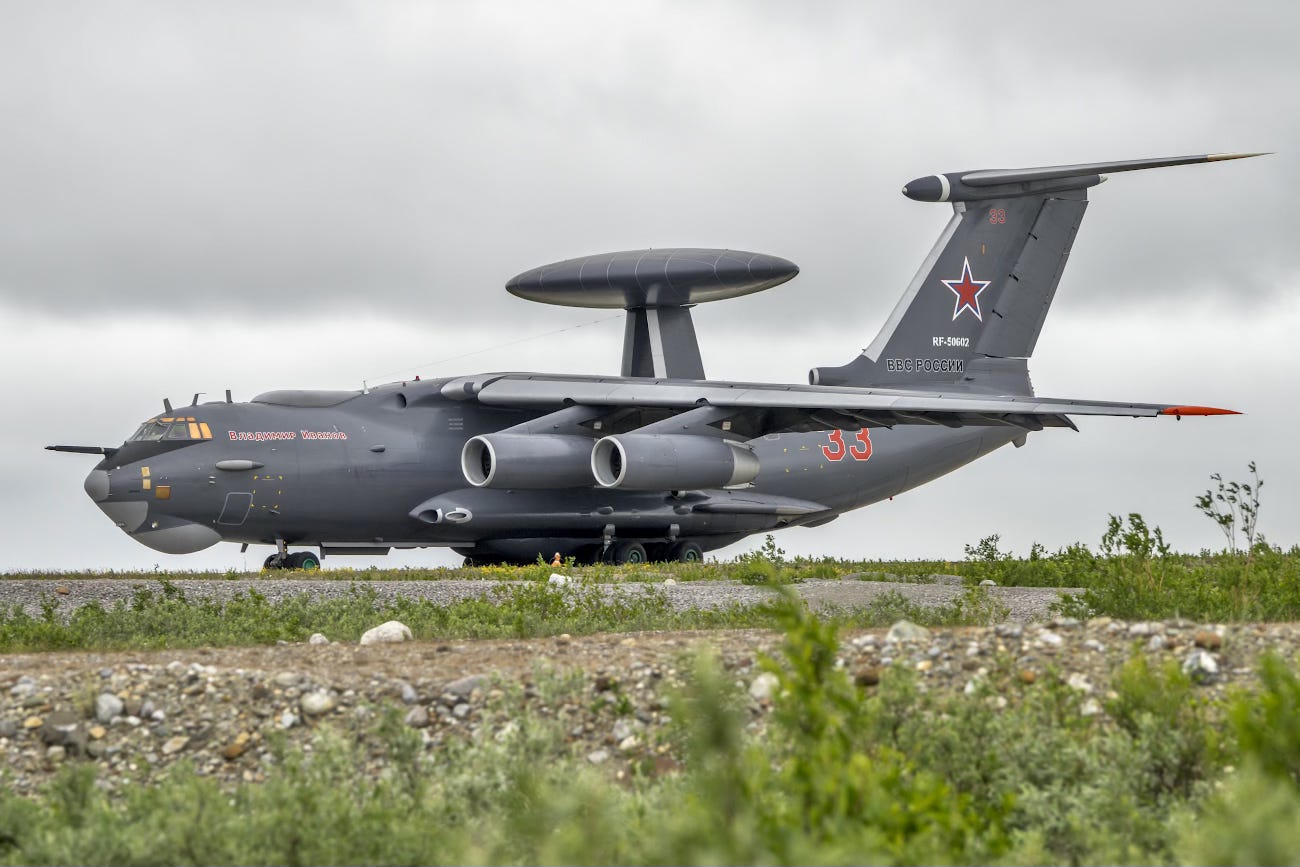
Let’s talk about it—the most talked-about aircraft of the moment: the A-50.
It has an almost alien look—bulky, with a massive radar dome on its back that makes it look like it came straight out of a Soviet sci-fi movie.
But don’t be fooled by the weird appearance: this plane is the flying brain of the Russian Air Force.
To be clear: the A-50 is the radar that sees everything.
It tells other planes where to go, who to strike, when to dodge.
It’s the eye in the sky of the Russian Federation.
It can detect aerial movements hundreds of kilometers away and, most importantly, it warns of incoming threats before they arrive.
For Moscow, it’s not just useful—it’s vital.
And here comes the twist.
The video released today by the SBU (Ukraine’s Security Service) shows something staggering: two A-50s hit.
Now let’s do some math together.
How many A-50s does Russia have?
Simple question, much trickier answer.
Short version: We don’t know.
Long version: Before the invasion of Ukraine, it was estimated that Moscow had around 10 A-50s.
Out of those, at least 3 were already out of service—parked, maybe beyond repair.
That would leave 7.
Here’s what happened to 2 of those 7:
January 14, 2024 — A-50U shot down over the Sea of Azov
February 23, 2024 — A-50U shot down in the Krasnodar region
Result: we’re down to 5 left.
But to be generous, let’s round it up to 6—maybe they dragged another one out of a hangar and patched it up as best they could.
Now pay attention: if satellite images confirm that the two A-50s shown in the video were indeed destroyed on June 1st,
Russia could be left with only 4 operational A-50s.
Possibly 5, if they pull off a miracle.
A loss they simply can’t afford.
Not when your entire air defense system—from missiles to interceptors—relies on them.
So that’s it, right?
Time to congratulate the Ukrainians!
Well… not quite.
Because there’s one small detail that complicates everything:
we don’t know if the two A-50s hit were among the five operational ones—or among the three (or more) that were already out of commission.
That’s the riddle.
So how do we solve it?
One possible way is to check how long those two aircraft had been parked on the tarmac.
If they’d been sitting there for months, lifeless, maybe they were already dead.
But if they were active, in rotation,
then yes—Russia may have just lost the last “eyes” it had left.
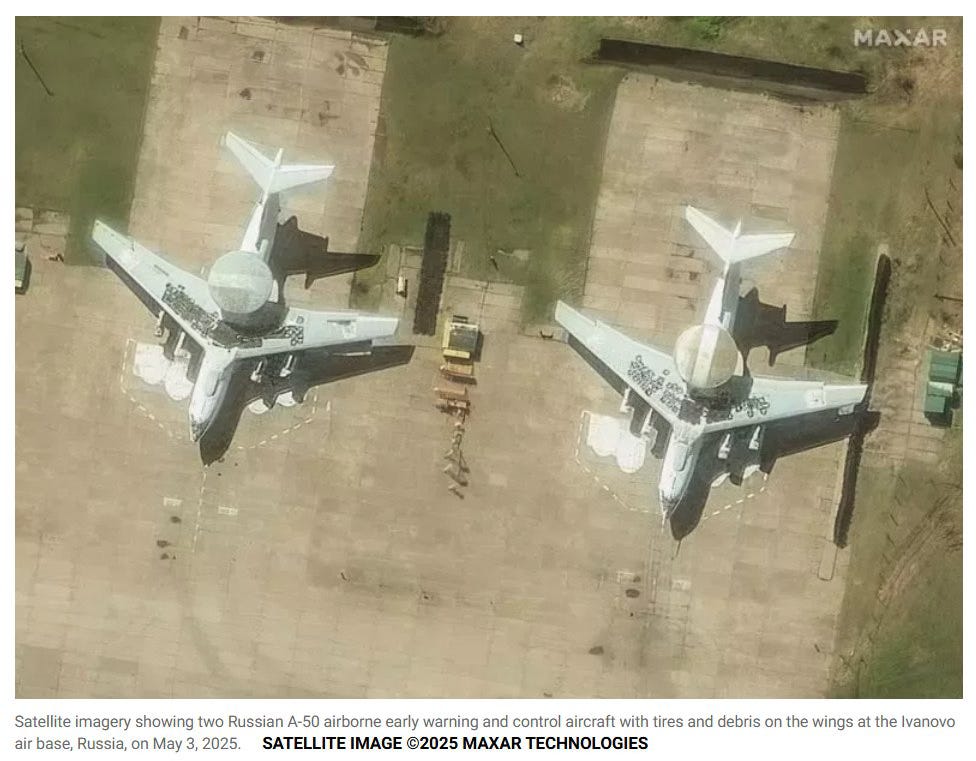
There they are — the two A-50s, photographed on May 3rd, 2025. About a month before the attack.
We can clearly see them parked on the runway, but there’s a problem: I can’t find any reliable earlier images that confirm they were there before that date.
And more importantly, we have no evidence that either of them ever took off during that month.
If any of you have information, tips, or better sources: drop it in the comments.
Now let’s get to a detail that — surprisingly — many seem to have missed.
Take a close look at the two radar domes.
Notice anything odd?
Both show a lighter stripe down the center, while the edges appear dark, dirty,
Cluttered.
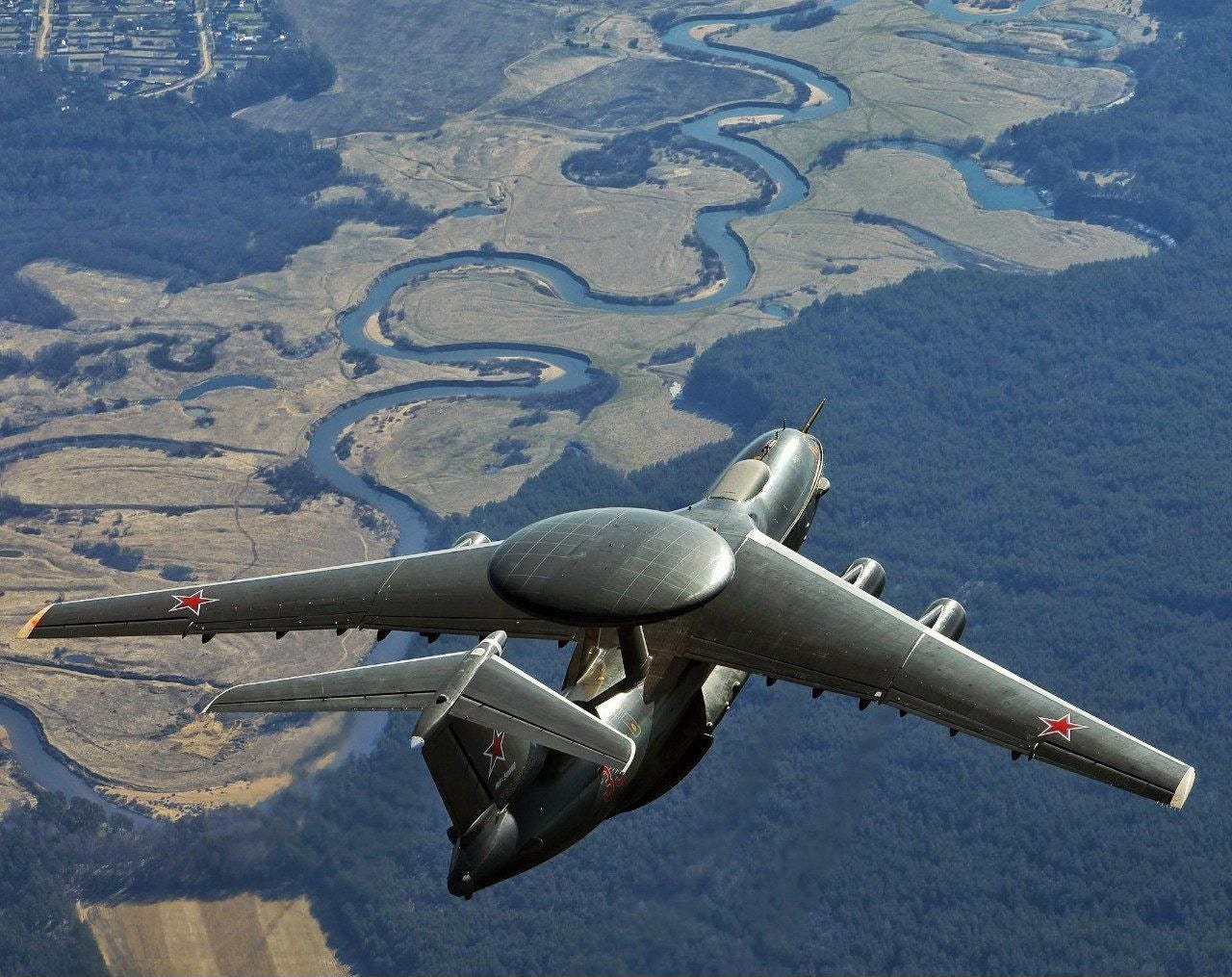
I’m also including an archival image of an A-50 shot from above, just for comparison.
That aircraft is black, with two stars on its wings, but — and this is key — its dome isn’t dirty.
It’s clean, uniform, well maintained.
And this raises a question as big as the A-50 itself:
Were the two A-50s that got hit actually in service... or were they just left there to rot?
Because — let’s not sugarcoat it — they look like junk.
Cloudy domes, grimy fuselage, zero maintenance.
Sure, maybe this is standard practice in the Russian Air Force when it comes to handling their most sensitive assets, but to me — and maybe to you too — these two planes look like they’d been abandoned for quite a while.
And that changes the picture yet again.
Because if those airborne radars were already out of commission, if they were just hollow shells collecting dust, then the strategic impact of the strike drops dramatically.
The symbolism remains, the embarrassment for Moscow is undeniable... but the operational loss?
Still up in the air.
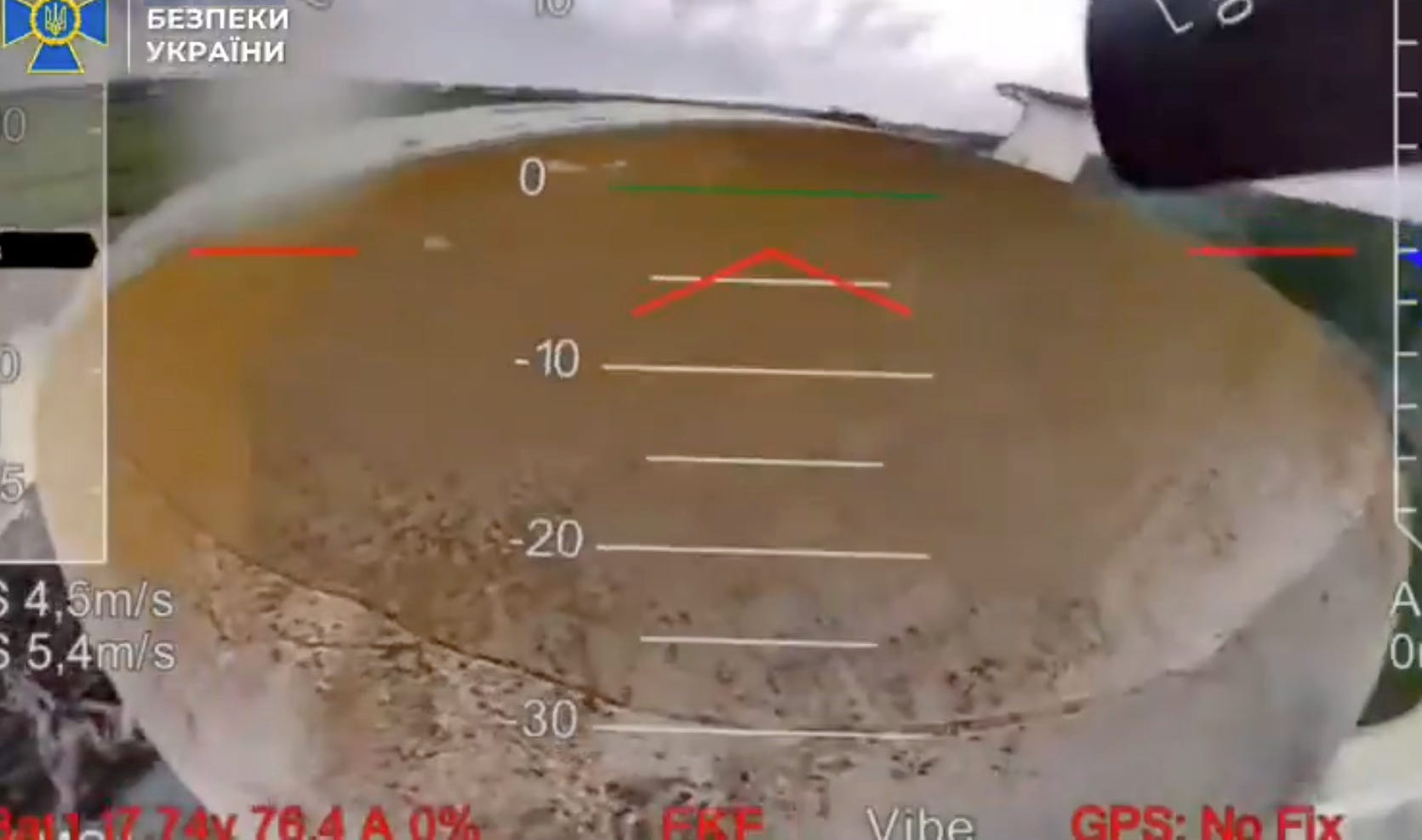
In this frame, taken from the video, we get a close look at the radar dome.
Your eye is immediately drawn to that dark, unsettling section.
At first glance, it looks like rust. But that’s unlikely. That part shouldn’t be metal — it should be polymers or composite materials, specifically designed not to interfere with the radar.
So what is it? We don’t know.
Dirt? Wear and tear? Neglect? It’s hard to say for sure.
But here’s the thing: this isn’t an isolated case.
The entire aircraft looks neglected.
They look abandoned.
Like carcasses, left to rot on the tarmac.
And if that’s what they really were… maybe there wasn’t much left to destroy.
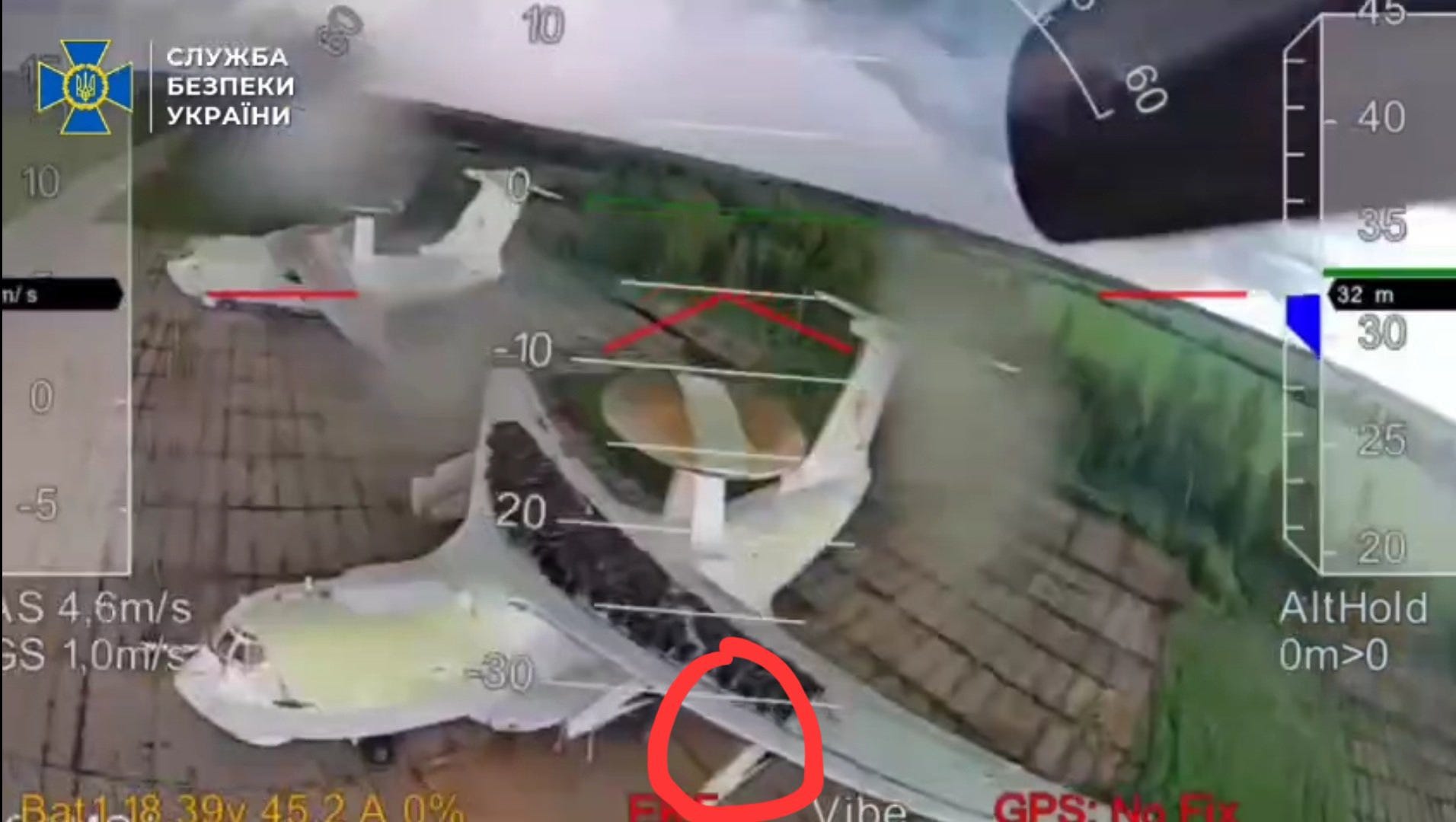
There’s another detail that raises eyebrows: the two A-50s appear to be missing their engines.
And at that point, let’s be clear: they might not be total junk, but they were certainly not ready for takeoff.
Even though, in the satellite images from May 3rd, the two planes appear to have engines, maybe they were removed?
Maybe they're not the same planes? Hard to say.
Given what we know today, it’s hard to believe these aircraft were being used regularly in operations over Ukraine.
They don’t look airworthy, or combat-ready.
Let me know what you think in the comments.
Because if they really were out of commission, then they’re not worth 300 million dollars each, as I keep reading.
They’re worth whatever value a derelict hull has for the Russians — something to be stripped for spare parts.
In other words: close to zero.
Yes — despite the five-minute video, despite the 22 direct hits, this attack — on paper so spectacular — might turn out to be a massive swing and a miss.
That said...
Even if they were just old wrecks, what the Ukrainians pulled off remains impressive: infiltration, planning, surgical precision.
They got in. They struck.
And they did it right under Moscow’s nose.
Credit where it’s due.
But in practical terms...?
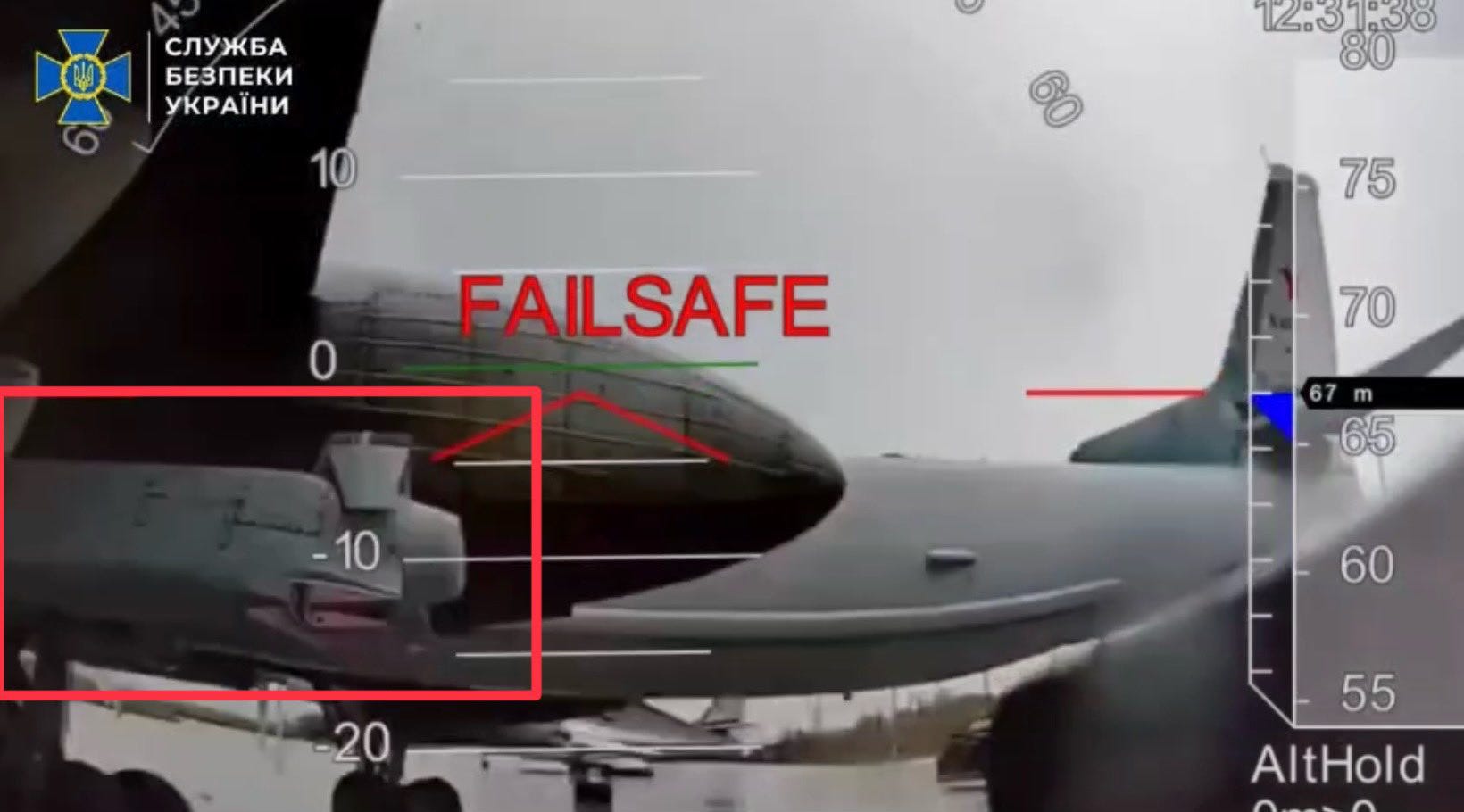
One thing, though, needs to be said.
In other frames of the video, you can spot some bombers with what appears to be a Kh-101 hanging under the wing.
We’re talking about a stealth, subsonic cruise missile, designed to strike targets from long range.
If it really is a Kh-101, then yes — at least one of the aircraft hit was operational.
Not a scrap heap, but a live platform, armed and ready to cause damage in Ukraine.
I’m not 100% convinced that’s what the missile actually is.
The video quality is low, and as they say, truth is the first casualty of war.
Propaganda flies faster than drones, and that’s why I prefer to tread carefully.
I suggest you do the same.
What do you think?
I’ll be reading the comments — and replying to all of them.
Per aspera ad astra.
Well-spotted!
The International Institute for Strategic Studies has also assessed those two A-50s as “almost certainly non-operational aircraft”. https://www.iiss.org/online-analysis/military-balance/2025/06/operation-spiderweb-an-assessment-of-russian-aerospace-forces-losses/
(Still worth more than the cost of one drone each, but of course absolutely not comparable in value to an A-50 that can be used.)